BLOG
BLOG
When fraudulent apps pretend to be you, the damage rarely starts in your codebase.
It starts in places most security programs don’t watch closely enough: app stores, third-party marketplaces, and alternate distribution channels.
Every well-known app eventually gets cloned. Sometimes it looks harmless. Most times, it isn’t.
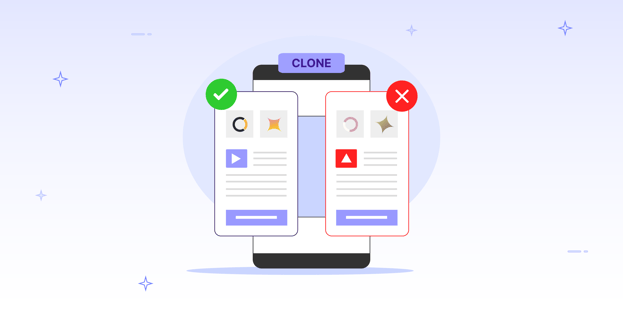
A publisher in a regional marketplace copies your icon and description.
A third-party store mirrors your listing but swaps the developer name.
A low-effort clone looks close enough to confuse users.
Users search for your app. They see multiple versions.
Many tap the wrong one.
This is how brand impersonation begins, and how it spreads faster than most teams expect.
In real-world investigations across fintech, consumer apps, and regional marketplaces, impersonation rarely announces itself through security alerts.
It shows up quietly.
Support tickets arrive first:
Security teams investigate and discover multiple variants across marketplaces.
Marketing notices declining downloads in regions that were previously stable.
By the time teams connect the dots, users have already been exposed.
The discovery pattern is remarkably consistent.
No one saw the fake apps appear because no internal tool was watching external stores.
Traditional AppSec tools were built to protect what you ship, not what others publish under your name.
They:
They cannot:
The gap isn’t technical.
It’s structural.
AppSec tools were never designed for marketplace surveillance.
Brand impersonation in app stores refers to unauthorized applications that mimic a legitimate app’s identity—name, icon, metadata, or publisher—to mislead users or distribute altered or malicious builds.
Once an app reaches a marketplace, it becomes accessible far beyond your control plane.
And attackers exploit that distance.
Storeknox applies the logic of modern security—continuous monitoring, evidence-backed response, and governance—to the distribution layer.
Instead of discovering impersonation after users are affected, teams gain early, structured visibility into:
Alerts integrate directly into workflow systems so teams can respond with context, not guesswork.
Each case includes:
Security teams receive a complete investigation package, ready for review.
Detection alone doesn’t stop impersonation.
Action does.
Once a listing is verified, teams can request takedown of impersonating apps directly, supported by captured evidence.
Every action is tracked:
This creates an audit trail that legal and compliance teams can rely on—especially when regulators expect proof of ongoing brand protection controls.
A popular fintech app sees a spike in fraudulent transactions.
Users unknowingly downloaded a clone from a third-party store.
The clone:
The issue surfaced only after customer complaints.
With continuous monitoring, this type of clone is flagged before it gains reach.
Effective brand monitoring requires more than ad-hoc checks.
|
Stage |
What teams need |
|
Detection |
Early alerts for look-alike listings |
|
Validation |
Evidence, screenshots, metadata |
|
Remediation |
Guided takedown workflows |
|
Governance |
Policies, audit trails, and reporting |
This is how brand impersonation becomes a managed security control, not a recurring fire drill.
High-performing teams define success clearly.
These reports transform brand monitoring from a reaction to a strategy.
Fake apps cause damage long before traditional tools detect anything.
They:
Monitoring app stores as closely as CI/CD pipelines is no longer optional.
It’s how modern security teams stay ahead.
|
Area |
What to watch |
|
Detection |
Look-alike listings, fake publishers |
|
Risk |
Credential theft, fraud, malware |
|
Response |
Evidence-backed takedowns |
|
Governance |
Policies, audit trails, reporting |
|
Outcome |
Faster resolution, reduced impact |
Brand impersonation is not a fringe issue.
It’s a predictable consequence of modern app distribution.
Teams that treat app stores as a monitored security surface—not a blind spot—respond faster, protect users more effectively, and reduce long-term risk.
When brand protection becomes structured, measurable, and continuous, security teams stop chasing clones—and start staying ahead of them.
Very common, especially in third-party and regional marketplaces where enforcement varies.
Through pattern matching across names, metadata, icons, and publisher identities.
Yes. Verified impersonation cases can be routed into takedown workflows with supporting evidence.
Yes. Alerts can be routed into existing security and incident management systems.
By reviewing historical logs, evidence, actions taken, and outcomes across monitored marketplaces.