
.png)


BLOG
Runtime tools test what an app does when it runs. Appknox tests what the binary contains before it does. Frida, MobSF, Objection, and Corellium compared
BLOG
 12 Mins Read
Frida hooks into your app's running process in seconds. It intercepts API calls, dumps the keychain, bypasses SSL pinning, and reveals exactly what the app does at runtime.
Frida is also the tool attackers use to do the same things to your users.
Runtime testing tells you what happens when an app runs under test conditions. It does not tell you whether the app can resist those same tools when an attacker uses them in production. That answer is not in the runtime session. It is in the binary.
The distinction that every mobile security engineer needs to know: Runtime testing observes what an app does when it runs. Binary analysis examines what the app is: what it contains, what configuration decisions were baked into it at compile time, and what an attacker will find when they probe it in the wild, not in a controlled test session.
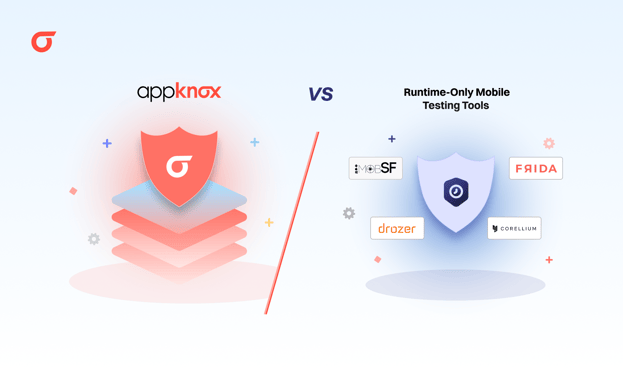
Runtime-only mobile testing tools (Frida, Objection, MobSF, Drozer, and Corellium) test application behavior during execution. Appknox performs binary SAST on the compiled artifact, AI-led automated DAST on physical iOS and Android hardware, and mobile API security testing, covering both the pre-execution binary layer that runtime-only tools cannot reach and the runtime layer they do reach.
This blog establishes precisely where runtime tools excel and where binary analysis closes the gaps they leave.
Runtime mobile security testing examines an application while it is executing. It observes what the app does: how it handles network requests, how it responds to injected inputs, what data it stores, and how security controls behave under active probing.
This is a different question from "what does the binary artifact contain?" Runtime testing cannot answer the second question because it operates on the running process, not the compiled file. Understanding what each tool in this category actually is prevents the conflation that leads most teams to believe they have covered more ground than they have.
Frida is a dynamic instrumentation toolkit. It injects a JavaScript engine into a running iOS or Android process, enabling security engineers and attackers to hook any function, intercept any API call, bypass certificate pinning, and dump memory at runtime.
It is the most powerful and widely used tool in mobile security research and is also the primary instrument attackers use to reverse-engineer production apps. This dual-use nature is not incidental to what Frida is. It is definitional.
Objection is built on Frida and abstracts the most common pen test operations into a higher-level command-line interface. Keychain dumping, SSL pinning bypass, jailbreak detection bypass, and file system exploration require fewer lines of custom script.
Objection accelerates what Frida can do. However, it does not extend its scope.
MobSF is the open-source tool that most closely resembles a comprehensive testing platform. It performs static analysis on APK and IPA files and dynamic analysis on emulators or rooted devices, not real production-equivalent hardware. Certificate pinning behavior, hardware-dependent cryptographic operations, and device-specific API flows differ in emulated environments. iOS dynamic analysis requires Corellium infrastructure or a jailbroken device.
MobSF produces no MASVS-level compliance evidence and does not scale across a portfolio of enterprise applications.
For the full picture of what binary-based analysis finds that MobSF's static layer misses,
Drozer is an Android-only attack surface testing tool. It interacts directly with the Android Runtime (ART) and IPC mechanisms (content providers, activities, broadcast receivers) to test how Android components expose attack surfaces.
Drozer is the best tool available for this specific class of Android vulnerability. It performs no static or binary analysis and, as an archived project, receives no active maintenance.
Corellium is a virtual device infrastructure, not a security testing tool. It creates iOS and Android virtual devices that security researchers use as the hardware substrate for Frida, Objection, and other runtime tools.
Corellium enables dynamic analysis of iOS without a physically jailbroken device. It does not perform binary analysis, generate SBOM, produce compliance evidence, or integrate into CI/CD pipelines as an automated testing system.
Appknox performs Automated Vulnerability Assessment across three layers:
No source code is required.
KnoxIQ validates exploitability across all findings and reduces false positives to below 1%. Testing is triggered automatically on every build via a CI/CD webhook.
|
Capability |
Appknox |
Frida |
Objection |
MobSF |
Drozer |
Corellium |
|
Tests compiled binary before execution |
Yes |
No |
No |
Partial (static only) |
No |
No |
|
Tests on real physical devices |
Yes (AI-led, automated) |
Yes (manual) |
Yes (manual) |
No |
Yes (manual, Android-only) |
No (virtual only) |
|
Tests on emulators / virtual devices |
No |
Yes |
Yes |
Yes |
Yes (manual, Android only) |
Yes |
|
Requires an expert operator per session |
No |
Yes |
Yes |
Partial |
Yes |
Yes |
|
CI/CD automation at enterprise scale |
Yes |
No |
No |
Partial |
No |
No |
|
Authenticated DAST sessions |
Yes |
Manual setup |
Manual setup |
No |
No |
No |
|
OWASP Mobile Top 10 2024 mapping |
Yes |
No |
No |
Partial |
Partial (Android) |
No |
|
MASVS compliance evidence |
Yes |
No |
No |
No |
No |
No |
|
Binary SBOM generation |
Yes |
No |
No |
No |
No |
No |
|
Third-party SDK audit at the binary level |
Yes |
No |
No |
No |
No |
No |
|
Binary hardening verification |
Yes |
Partial (runtime probe) |
Partial (runtime probe) |
Partial (static) |
No |
No |
|
Post-release app store monitoring |
Yes (Storeknox) |
No |
No |
No |
No |
No |
|
False positive rate |
Less than 1% (KnoxIQ) |
N/A (manual) |
N/A (manual) |
Not specified |
N/A |
N/A |
|
Compliance-ready audit reporting |
Yes |
No |
No |
No |
No |
No |
|
Gartner Peer Insights rating |
4.8 / 5 |
N/A |
N/A |
N/A |
N/A |
N/A |
|
Licensing model |
Commercial |
Open-source |
Open-source |
Open-source |
Open-source (archived) |
Commercial |
Six categories of vulnerability are invisible to runtime-only tools until they are exploited. These live in the binary and do not announce themselves in a test session.
Android build flags like android:debuggable and android:allowBackup are set at compile time. Certificate pinning enforcement is configured in the binary. A runtime tool can confirm these controls work during a test session. It cannot verify they exist in the compiled binary before the app ships.
Binary analysis reads the artifact directly.
Runtime tools observe what an SDK does during execution. They do not audit all CVEs in the compiled SDK component because vulnerable code paths may never be triggered during a test session.
87% of commercial codebases contain at least one known open source vulnerability (Black Duck OSSRA 2026). The SDK linked into a mobile binary is the same supply chain risk in a pre-compiled form that no source-code scanner can reach, and no runtime session will reliably surface.
Code obfuscation is applied at compile time. A runtime tool can attempt to probe whether obfuscation can be bypassed; Frida is commonly used for this.
However, Frida cannot verify that obfuscation was applied correctly across all sensitive components before the app ships. Binary analysis inspects the artifact.
Runtime tools observe what executes during the test session. They cannot enumerate every component in the binary that never gets called in that session.
A binary SBOM inventories everything present in the artifact, whether or not it is executed.
Runtime observation maps what data flows during the test. It does not capture the complete set of data collection operations across all SDK behaviors and all app states that the test never reached.
Code quality controls, cryptographic implementation standards, and binary protection requirements must be verified at the artifact level. Runtime observation confirms behavior under test inputs. It does not verify the underlying binary structure that compliance frameworks require evidence for.
Frida is the world's most widely recommended tool for mobile runtime security testing. It is also the primary tool that attackers use to
An app that passes a Frida-based security test has proven it survived that test session. It has not been proven that the binary hardening controls that make it resistant to Frida-based attacks in the wild (obfuscation, anti-tampering, jailbreak detection) are present and effective in the compiled binary.
Binary analysis verifies that those controls exist before the app ships. A runtime test confirms the controls held during the test. The two questions are not the same question.
A security engineer runs MobSF dynamic analysis on a banking app. The emulator session completes cleanly: no certificate pinning bypass, normal network behavior, no visible data leakage. The test passes.
The same app links four third-party analytics SDKs as compiled binaries. One carries a high-severity vulnerability with a CVSS score of 8.1. The vulnerable code path does not trigger during the emulator session. Appknox identifies it in the binary within 60 minutes of the build completing.
The MobSF dynamic test returned a clean result even though the binary contained a critical exposure the entire time.
Exploitation windows have collapsed from weeks to days (Google Cloud CISO Perspectives, March 2026). The window between binary completion and production deployment is now shorter than the average pen test cycle.
Four misconceptions explain why the pre-deployment gap persists in otherwise mature security programs.
Runtime testing confirms the app survived the test inputs applied during that session. It does not cover every code path, every SDK dependency, or every build configuration property.
The test session is a sample of the app's behavior under the specific conditions the test engineer created. The binary is the complete artifact.
Passing a runtime test means the session ran cleanly. It does not mean the binary artifact is secure.
MobSF's dynamic analysis runs on emulators or rooted devices.
Certificate pinning under real network conditions, hardware-dependent cryptographic operations, and device-specific API behaviors differ from emulator behavior in ways that matter for security testing.
MobSF's static analysis provides a useful baseline on decompiled APK/IPA content. It does not generate MASVS-level compliance evidence, does not integrate into enterprise CI/CD workflows at portfolio scale, and does not produce the audit-ready reporting that regulated industries require.
This is the Frida Paradox. Testing with Frida under controlled conditions confirms that a trained security engineer could hook the app during the test session. It does not verify that the binary hardening controls (obfuscation, anti-tampering, jailbreak detection) that make the app resistant to the same techniques an attacker uses in production are correctly implemented in the compiled binary.
A Frida test that passes is evidence that the test ran. Binary analysis is evidence that the app is protected.
Running Frida or Objection on a real physical device is more accurate than emulator testing for runtime behavior.
Hardware-dependent conditions, real network behavior, and actual device state improve the quality of runtime findings. This does not change what runtime testing is: observation of the running process.
Binary SAST, SDK supply chain analysis, SBOM generation, and build configuration verification require analysis of the compiled artifact. The device does not change what the binary contains.
You need to test the compiled binary before it runs
Build configuration properties, SDK CVEs, obfuscation coverage, and SBOM completeness are only verifiable through binary analysis. Runtime tools cannot reach these properties until an attacker finds them in production.
You need automated security testing on every build
Frida and Objection require a skilled security engineer to operate each session. MobSF static analysis can be integrated into CI/CD, but its dynamic analysis requires manual setup per session.
Appknox triggers automatically via webhook on every build, completes binary scanning within 60 minutes, and routes findings to Jira, Slack, or GitHub Issues. No operator is required for each scan cycle.
You need compliance evidence at the artifact level
Compliance with MASVS and OWASP Mobile Top 10 2024 requires testing the compiled artifact against specific controls. Runtime tools do not produce MASVS-mapped compliance reports.
Appknox produces audit-ready evidence covering OWASP Mobile Top 10 2024, MASVS, MASTG, PCI-DSS, HIPAA, GDPR, DPDP, and PDPA.
You need to audit third-party SDK binaries at scale
Runtime tools observe SDK behavior during execution. They cannot enumerate all CVEs in compiled SDK components that may never trigger during a test session.
Appknox generates a complete binary SBOM and cross-references against current CVE databases on every build.
You are managing a portfolio of mobile apps across teams
Frida and Objection are single-app, single-session tools.
Appknox scales across a portfolio with a unified CISO Dashboard, MTTR tracking per team, and coverage rate monitoring across every app in production.
For the comparison against source-code SAST tools that face a similar architectural limitation,
Check out: Appknox vs Code-Centric SAST Tools
You need a skilled pen tester to probe specific attack scenarios
Frida and Objection give security researchers the ability to write custom scripts, hook specific methods, and probe exact attack vectors they are investigating. This depth of manual behavioral probing is what expert-operated runtime tools are built for.
For targeted penetration testing of specific app flows, runtime tools are the right instrument.
You are doing a first-time baseline analysis on an unknown binary
MobSF's combination of static analysis and emulator dynamic testing is a fast, free baseline for understanding what an app does before investing in deeper analysis.
You need to test behavioral responses to injected inputs under expert control
Runtime instrumentation via Frida scripts tests how an app responds to specific hooked methods, modified return values, and injected data. This level of behavioral manipulation complements binary analysis rather than replacing it.
You are a security researcher conducting a manual assessment, not an enterprise team running automated portfolio testing
The runtime toolchain is optimized for individual expert operators. Enterprise-scale automated testing across a mobile portfolio requires a different architecture.
For deeper coverage of what source-code scanners miss alongside runtime tools,
Yes, but not as alternatives. As sequential layers at different moments in the security program's cadence.
The framing that creates confusion is "Which tool should we use?"
The accurate framing is "which layer does each tool cover, and at what frequency?"
Binary analysis runs on every build, automatically, the moment the binary exists. Runtime pen testing runs periodically, by an expert operator, against specific attack scenarios. Post-release monitoring runs continuously after deployment. These are not competing answers to the same question. They are answers to different questions asked at different stages of the app's lifecycle.
Appknox also offers Manual Penetration Testing as a core product.
For teams that need both automated binary and runtime testing and expert-led penetration testing in a single workflow, Appknox covers all three layers without requiring a separate toolchain or vendor relationship.
|
Layer |
Tool |
Cadence |
What it tests |
|
Binary analysis |
Appknox binary SAST |
Every build (automated) |
Compiled binary: SDK CVEs, build flags, SBOM, binary hardening |
|
Runtime testing (automated) |
Appknox real-device DAST |
Every release candidate |
Real-device runtime: API auth, certificate pinning, session handling |
|
Post-release monitoring |
Continuous |
App store: unauthorized builds, binary drift, fake apps |
|
|
Runtime testing (manual/research) |
Frida + Objection |
Periodic pen test |
Custom probing: method hooking, behavioral injection, targeted exploit research |
|
Baseline / first evaluation |
MobSF |
Initial assessment |
Quick static plus emulator dynamic baseline before deeper investment |
The manual and automated layers serve different moments in the security program. They are not redundant.
The same layered logic applies to runtime protection.
If your security program includes RASP alongside testing, see Why Only Having a RASP Tool Is Never Enough for Security for why pre-deployment VAPT and runtime protection address different problems and why both are required.
For the broader comparison across ASPM and posture management tools that face a different but related positioning question,
Check out: Appknox vs ASPM Vendors
Runtime testing answers one question: “What does this app do when I probe it?”
Binary analysis answers a different question: “What is this app, what does it contain, and what configuration decisions were fixed into it at compile time before it ever ran?”
Both questions matter.
The second has an answer that is fixed from the moment the binary is compiled. Runtime tools can find it if a test session happens to trigger the right code path under the right conditions.
Binary analysis finds it in the artifact before any session begins, before the app reaches a single user, and before an attacker has the opportunity to ask the same question.
The most exploitable mobile vulnerabilities are those that do not announce themselves during a test session. They wait. Binary analysis does not wait with them.
See what Appknox finds in your binary before your next release.
Bring your APK or IPA. Leave with binary findings confirmed against your actual build.
Appknox includes real-device DAST that tests mobile app behavior on physical iOS and Android devices with authenticated sessions, making it a dynamic analysis tool for mobile apps. The tool also performs binary SAST on the compiled artifact, providing the enterprise-depth binary analysis and compliance mapping that runtime-only tools do not cover.
Appknox is a comprehensive mobile security platform that covers the binary, runtime, and API security layers, which runtime-only tools address only partially.
Frida is a legitimate and powerful tool for authorized security testing. It is also the primary tool attackers use to bypass certificate pinning, dump credentials, and circumvent security controls in production apps. This dual-use nature means two things.
MobSF is a valuable open-source baseline tool. It does not scale to enterprise portfolio testing, does not produce MASVS-level compliance evidence, and its dynamic analysis runs on emulators rather than real devices. For teams needing automated testing on every build across a portfolio of apps with audit-ready compliance reporting, a purpose-built platform is required.
Appknox helps you find six categories that exist in the binary before the app ever runs: build configuration flags, third-party SDK CVEs, obfuscation effectiveness, binary SBOM completeness, privacy data collection across all app states, and MASVS/OWASP static compliance controls. Runtime tools only surface these if the right code path happens to trigger during the test session. Binary analysis finds them in the artifact regardless.
MobSF has a CI/CD integration mode for static analysis and basic dynamic analysis on emulators. Frida and Objection require manual operation by a skilled engineer and are not designed for automated per-build pipeline integration. Appknox integrates natively with GitHub Actions, Jenkins, GitLab CI, CircleCI, Bitrise, and Azure DevOps via webhooks, triggering automatically on every build without manual intervention.
Corellium is a virtual device infrastructure platform. It creates iOS and Android virtual devices that security researchers use as the substrate for running Frida, Objection, and other runtime tools. It is particularly valuable for iOS dynamic analysis that would otherwise require a jailbroken physical device.
Corellium does not perform binary analysis, generate SBOM, produce compliance evidence, or integrate into CI/CD as an automated testing system. It is the infrastructure layer, not the testing layer.
Reviewed by the Appknox Security Research Team. Tool capabilities based on official documentation and independent security research assessments as of mid-2026. No vendor provided sponsorship or editorial input.

Hackers never rest. Neither should your security!
Stay ahead of emerging threats, vulnerabilities, and best practices in mobile app security—delivered straight to your inbox.
 Exclusive insights. Zero fluff. Absolute security.
 Join the Appknox Security Insider Newsletter!

