BLOG
Validate security, privacy, CI/CD traceability, and store compliance before submission. A practical mobile app release readiness checklist for AppSec teams.

.png)


BLOG
 9 Mins Read
Every mobile team has shipped an app that technically worked, and still caused problems.
Sometimes it’s a last-minute App Store rejection.
Sometimes it’s a privacy disclosure mismatch.
Sometimes it’s a vulnerability discovered days after release, when rollback is no longer clean.
The pattern is consistent, which isn’t a lack of tooling but a lack of release readiness clarity.
Release readiness isn’t about perfection.
It’s about answering one question with confidence:
“Do we understand the risk we are about to publish, and could we defend this decision months from now?”
In web environments, mistakes can be patched quickly and quietly.
In mobile, once an app is released:
Mobile releases are durable.
You are not just deploying code. You are making publishing decisions.
This permanence changes how risk should be evaluated. What could be corrected in staging becomes reputational once indexed by an app store.
Release readiness, therefore, is not just a security checkpoint.
It is a governance decision.
Bottom line
Mobile release readiness exists because distribution is irreversible and visibility is public.
In working with enterprise mobile teams, one recurring pattern stands out:
Most release failures are not caused by unknown vulnerabilities.
They are caused by unclear decisions.
Release readiness does not mean:
It does mean:
This distinction matters.
The difference between mature and fragile release processes is not risk elimination. It is decision clarity.
No checklist eliminates uncertainty.
It eliminates ambiguity.
This checklist is most effective when used:
As you read, ask yourself:
If the answer is unclear, the app isn’t release-ready yet.
Release failures rarely begin with technology. They begin with ambiguity.
Engineering assumes security will escalate.
Security assumes the product team will intervene, and
The product team assumes validation has already occurred.
The release proceeds, not because risk was approved, but because it was never formally challenged.
In mature organizations, responsibility is shared, but never vague.
When ownership is unclear, risk is not assessed. It simply moves forward.
In our work with enterprise teams, release breakdowns rarely happen due to indifference. They happen because accountability was implied instead of assigned.
This is how disciplined organizations structure release readiness before submission.
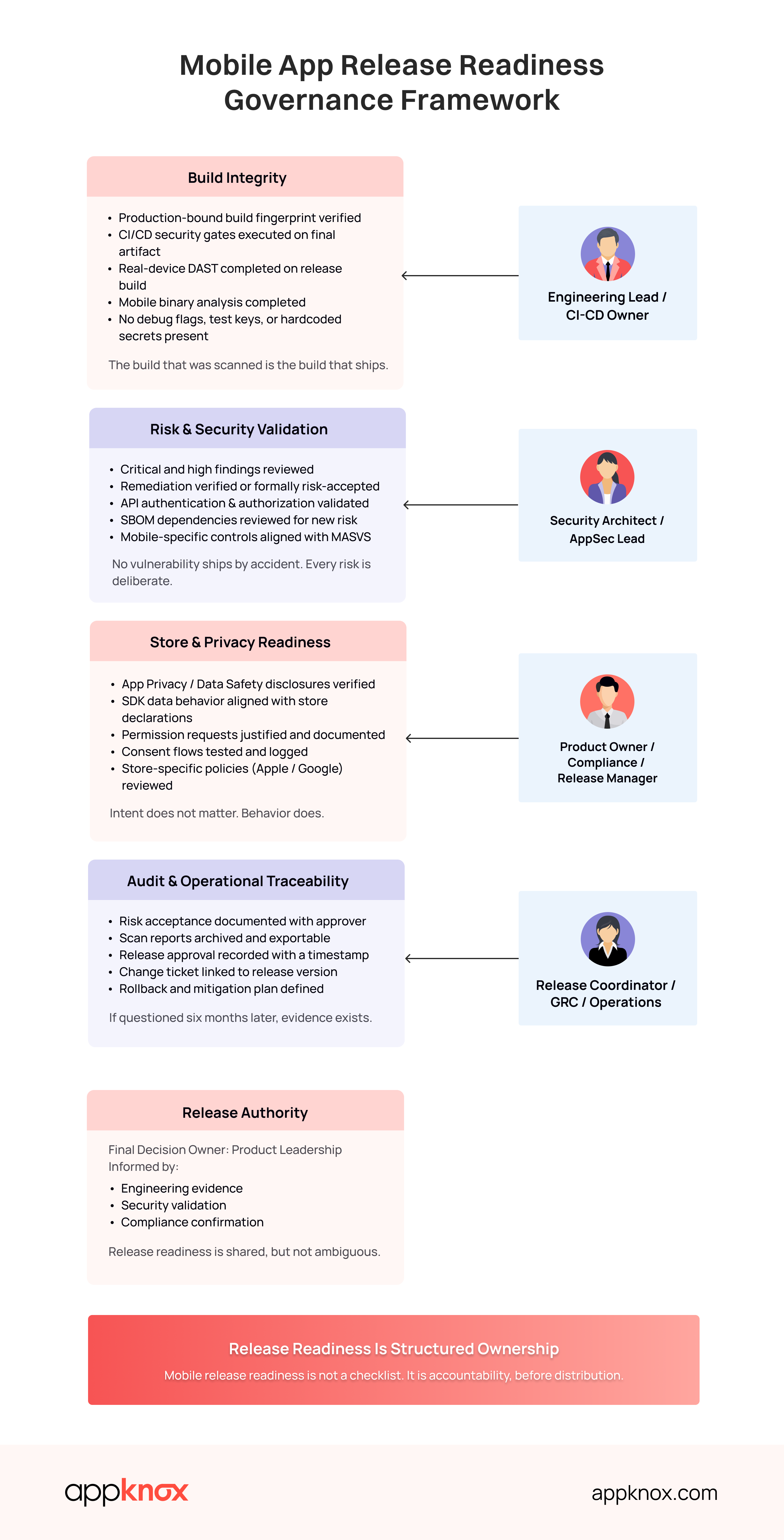
Notice the pattern: each layer has a defined owner. No layer operates in isolation.
That structure is what turns coordination into governance.
|
Function |
Core responsibility |
|
Engineering |
Build integrity & implementation |
|
Security |
Risk validation & severity thresholds |
|
Product |
Final release decision |
|
Compliance / GRC |
Audit evidence & traceability |
One of the most common mobile release failures is simple and costly: teams scan one build and ship another.
In many organizations, this is what “release readiness” looks like:
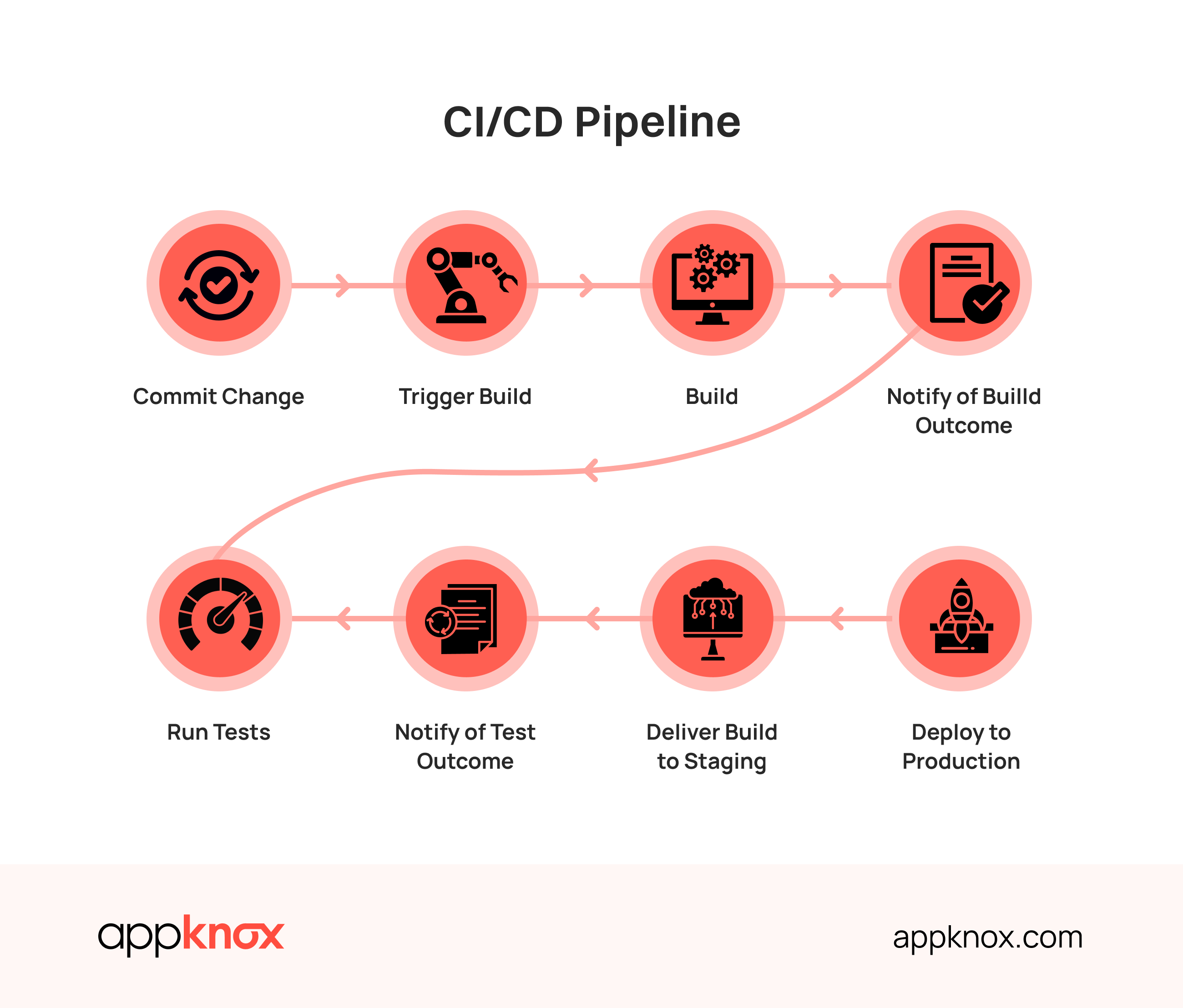
If the pipeline passes, the release proceeds.
But here’s the problem.
CI/CD validates automation. It does not validate accountability.
Release readiness does not begin at the store. It begins with the build.
Before discussing risk acceptance or compliance, there is a more fundamental question:
“Are we certain the build being shipped is the one that was validated?”
Build integrity means the production-bound artifact was scanned, security checks were run automatically in CI/CD, and every result is tied to a specific release version. Nothing was skipped under pressure. Nothing was assumed.
If scan results cannot be traced to the exact binary in the store, the release decision rests on memory rather than evidence.
That is not a tooling gap.
It is a traceability gap.
And traceability is what turns a deployment into a defensible decision.
A team runs security scans on what they believe is the final build.
Two days later, a hotfix is merged to fix a UI issue. The pipeline passes. No one reruns the scans because “nothing security-related changed.”
A week after release, a review flags a hardcoded token introduced in that hotfix.
The issue was a missing link between the build identity and security evidence.
What does this mean?
Release confidence begins with build-to-store traceability.
Every release contains unresolved findings.
The question is not whether issues exist.
It is whether they were consciously evaluated.
Mature teams define severity thresholds in advance. They do not negotiate risk under deadline pressure.
When a critical issue remains open, the conversation must answer:
Blocking blindly slows delivery.
Shipping blindly erodes trust.
The dividing line is documentation.
A critical issue is found late.
Engineering assumes security will block it if needed.
Security assumes engineering has mitigated it.
The issue ships, not because it was approved, but because no one explicitly rejected it.
That’s accidental risk acceptance. Leaders recognize it immediately.
Bottom line
If you cannot name who approved a known exposure and why, the risk was not accepted. It was overlooked.
Mature teams don’t block releases reflexively. They move forward when risk is documented, compensating controls are clear, and rollback paths are understood. The difference isn’t courage. It’s clarity.
Blocking without context slows teams down.
Shipping without clarity creates long-term damage.
Mobile introduces exposures that do not exist in traditional web environments:
Secrets embedded in binaries.
Insecure local storage.
Over-permissioned sensors.
Debug artifacts left in production builds.
Many of these align with OWASP MASVS and Mobile Top 10 categories. Yet they are often underprioritized in web-centric validation models.
Unfortunately, these are exactly the issues app stores and attackers look for.
Session data is stored locally to improve performance.
The app passes QA. No alerts fire.
Months later, a penetration test shows sensitive data retrievable from the device.
The issue wasn’t a complex exploit.
It was a mobile-specific decision that never surfaced during release checks.
Key takeaway
If validation treats mobile like web, release readiness inherits web assumptions.
Mobile applications depend on backend APIs. Even when the client code appears stable, backend exposure can shift.
API exposure is not limited to authentication. It includes:
Many post-release incidents trace back to APIs that were assumed to be “unchanged.”
One release passed internal validation while a backend refactor was underway. The UI functioned normally. After distribution, the abuse traffic targeted an endpoint that had not been reassessed.
The app was functional. The exposure was not.
Release readiness must extend beyond the binary.
Key takeaway
Backend changes alter mobile risk posture, even when the UI remains unchanged.
A growing number of mobile release failures aren’t caused by vulnerabilities, but by privacy mismatches.
A few common examples include:
Modern release readiness must verify:
App stores don’t care what you intended. They care what your app does.
An analytics SDK update resolved a crash and passed internal validation, and the app is submitted with unchanged disclosures. No one revisited data disclosures.
The store detected additional background tracking and rejected the build, delaying the release.
The team had not intended to change privacy posture but assumed that SDK behavior stayed the same.
But stores evaluate behavior, not intent.
Key takeaway
Store compliance is about behavioral alignment, not documentation alone.
Mobile security does not end at validation. It enters a new environment: the store.
And stores operate under their own logic.
Google Play and Apple App Store do not enforce the same policies in the same way.
They do not evaluate metadata identically.
They do not interpret permissions uniformly.
Yet many teams assume that passing one is evidence of passing both.
That assumption holds until it doesn’t.
Release readiness at this stage is not about vulnerability scanning.
It is about alignment between:
Security may be technically sound.
But stores enforce behavioral transparency, not internal assurance.
The moment of friction often comes not from weakness, but from drift.
A release clears Google Play without issue.
The same build is submitted to Apple.
It is rejected for insufficient disclosure around background data access.
Nothing about the code changed.
Nothing about security posture changed.
What changed was the interpretation environment.
The team scrambles not because the app is insecure, but because store-specific nuance was not revisited.
Bottom line
Passing one platform does not validate the other.
Each store enforces policy through its own lens, and those lenses evolve.
Mature teams treat store validation as a separate checkpoint, not an automatic consequence of technical approval.
“Have we validated this release against the expectations of each distribution platform independently?”
If the answer is no, release readiness is incomplete.
Key takeaway
App store readiness is not a formality.
It is a policy-specific governance layer that must be reassessed every release, even when the code appears unchanged.
Release decisions are rarely scrutinized the day they are made. They are questioned months later, especially after:
By then, the release is not a recent memory.
It is institutional history.
This is where many organizations discover the difference between having reviewed a release and being able to defend it.
During the release cycle, the questions are practical:
But during an audit, the questions change to:
Where is the evidence?
Who signed off?
What was the rationale?
What data supports the decision?
Process memory does not satisfy those questions. Traceability does.
Release readiness becomes durable only when it produces artifacts that outlive the team’s recollection.
Six months after a release, an incident triggers a review.
Leadership asks a simple question:
“Why did we decide this version was safe?”
The team can describe the process.
They remember the conversation.
They recall the tradeoffs.
But they cannot produce documented evidence linking the final build to validated findings and recorded risk acceptance.
In that moment, the issue is no longer the vulnerability.
It is the decision itself.
“If this decision is examined six months from now, will we have evidence or explanations?”
Traceability is not bureaucracy.
It is institutional memory.
It ensures that release decisions remain defensible long after the context that shaped them has faded.
Without traceability, release readiness is fragile.
With traceability, it becomes governance.
Key takeaway
Release readiness is not complete until the decision is exportable, attributable, and defensible under audit.
|
Layer |
Hidden risk |
Maturity indicator |
|
Build |
Wrong artifact validated |
Build-tag traceability |
|
Risk Gates |
Implicit approval |
Documented acceptance |
|
Mobile Layer |
Binary exposure |
Device-aware testing |
|
Backend |
API drift |
Endpoint reassessment |
|
Privacy |
SDK mismatch |
Disclosure validation |
|
Audit |
Memory-based defense |
Exportable evidence |
Even mature organizations fall into the following predictable traps:
They often replace these with:
Release readiness becomes a system, not a scramble.
The most successful mobile releases are rarely celebrated.
They do not require emergency patches.
They do not appear in incident reports.
They do not resurface in board meetings or audit reviews.
They are quiet.
And in mobile security, quiet is earned.
It is not the absence of risk.
It is the presence of clarity.
Behind every uneventful release is a deliberate moment, a pause before submission, where someone asked:
That pause is release readiness.
It does not eliminate uncertainty.
No serious security leader claims that.
What it does is remove assumptions.
It replaces informal trust with documented evidence.
It replaces memory with traceability.
It replaces optimism with informed judgment.
Over time, that discipline compounds.
Releases become predictable.
Conversations become shorter.
Escalations become rarer.
And the organization stops reacting to mobile risk because it finally understands it.
Release readiness is not a final check before submission.
It is a signal of how seriously an organization treats ownership.
The quiet releases are not lucky.
They are accountable.
Release readiness is collaborative, but final accountability typically sits with product leadership, informed by engineering validation and security evidence.
Automation enforces consistency. It does not replace risk judgment. Release readiness combines automated validation with explicit ownership.
Release readiness ensures that an application meets defined security and quality benchmarks before it goes live. However, it does not account for how the application will behave once it is exposed to real users, environments, and threat actors.
After release, risk continues to evolve. APIs may be used in unexpected ways, automated attacks may target application workflows, and third-party components can introduce new vulnerabilities over time. These factors are often not visible during pre-release validation.
As a result, an application that passes all readiness checks can still encounter security issues in production. This is why mature security programs extend beyond release readiness and incorporate continuous monitoring, ensuring that risk is reassessed as the application operates in real-world conditions.
A release should be blocked when risk is undocumented, poorly understood, or indefensible under audit, not merely when issues exist.
No, but it's quite the opposite. Teams that formalize release readiness often experience fewer late-stage surprises, improving long-term velocity.
Release readiness validates risk before submission. Runtime monitoring observes behavior after distribution. Both address different phases of exposure.
Hackers never rest. Neither should your security!
Stay ahead of emerging threats, vulnerabilities, and best practices in mobile app security—delivered straight to your inbox.
 Exclusive insights. Zero fluff. Absolute security.
 Join the Appknox Security Insider Newsletter!


