
BLOG
Most mobile security tools detect vulnerabilities. Regulated enterprises need defensible governance. Learn what security leaders must evaluate instead.

.png)


BLOG
 12 Mins Read
Mobile security feels mature. Enterprises scan frequently, track findings, and report posture upward. Yet under regulatory scrutiny, cracks appear. This gap between perceived security and defensible governance is where mobile AppSec quietly fails. The illusion isn’t that security isn’t happening. It’s that it isn’t aligned with how regulated risk actually operates.
Mobile applications are no longer peripheral systems. They are primary revenue engines, patient engagement portals, payment interfaces, trading platforms, and enterprise control surfaces.
They process regulated data.
They expose core business logic.
They operate at the intersection of security, compliance, and brand trust.
And yet, mobile security evaluation is still often treated as an extension of web AppSec.
That assumption is where the governance gap begins.
Enterprises today operate mature security stacks. Scanners run continuously. Dashboards show activity. Metrics are tracked and reported upward.
Still:
This is not a budget issue.
It is an evaluation framework issue.
Most tools were designed to detect vulnerabilities.
Regulated enterprises need tools that defend decisions.
That difference is structural.
Most enterprise mobile security programs begin with compliance frameworks such as MASVS, OWASP Mobile Top 10, PCI-DSS, or HIPAA.
But compliance coverage alone does not guarantee security readiness.
In regulated environments we’ve worked with, teams often pass compliance checks while still carrying unresolved risk. This happens because frameworks define what should be validated, but not whether those validations remain true as the application evolves.
Mobile apps are not static systems:
A point-in-time compliance check cannot account for these shifts.
Security readiness is not defined by passing a framework once.
It is defined by the ability to continuously maintain alignment with that framework over time.
Security dashboards create comfort. Scans create metrics. Metrics create confidence. But regulated environments demand more than activity; they demand proof. The illusion of coverage arises when organizations mistake tooling presence for risk-control completeness.
Security programs are measured by activity:
But in regulated mobile environments, volume does not equal control.
Most enterprises already run:
These controls are necessary.
They are not sufficient.
Mobile applications introduce architectural properties that break web-centric assumptions:
Relying solely on web AppSec tools creates an illusion of visibility.
In reality, it creates partial insight.
And partial insight is dangerous in regulated environments.
Mobile applications are not smaller web apps. They are distributed software artifacts operating outside centralized infrastructure control. Their risk surface behaves differently, and so must their evaluation model.
Mobile applications alter the risk equation in ways that demand independent evaluation.
Mobile apps ship as compiled artifacts. Weaknesses may only manifest post-compilation:
Source code scanning alone does not reflect deployed risk.
Evaluation must operate at the binary layer.
Third-party integrations extend mobile functionality, but also extend risk. These components operate as embedded systems within your application, often outside direct development oversight.
Modern mobile apps embed analytics frameworks, payment processors, advertising SDKs, authentication libraries, and telemetry modules.
Each may:
Under GDPR, undeclared data flows become regulatory exposure.
Without SDK-level visibility, privacy risk remains invisible.
Mobile platforms impose policy governance externally. Unlike web systems, compliance can be publicly challenged before regulators ever intervene.
Mobile ecosystems enforce privacy declarations and behavior alignment.
If runtime behavior contradicts declared disclosures:
Security evaluation must extend beyond exploitability to declared-behavior alignment.
In mobile, remediation speed is not solely under enterprise control. Updates depend on user adoption patterns.
Unlike servers, mobile applications cannot be centrally patched.
Remediation depends on user updates.
This prolongs exposure windows.
Security tooling must therefore emphasize:
Because post-deployment correction is slower and riskier.
Regulators do not reward good intentions. They validate structured control. Mobile AppSec must therefore operate within compliance logic, not just technical detection logic.
Across frameworks such as:
The governing principle is clear: security must be demonstrable.
Regulators evaluate:
They ask structured questions:
Detection without documentation fails this test.
Mobile AppSec evaluation must produce durable governance artifacts.
If mobile AppSec is a governance discipline, then evaluation must shift accordingly. The right framework measures not just detection capability but also defensibility, operational alignment, and executive visibility.
Regulated enterprises must evaluate mobile AppSec across seven structural pillars.
Depth defines credibility. Without mobile-specific inspection at the binary and runtime level, risk assessment remains incomplete.
Mobile-native inspection must include:
Surface-level mobile support is insufficient.
Depth determines real-world risk visibility.
Framework alignment must translate into artifacts that regulators can consume, not just labels that security teams recognize.
Framework references must translate into structured artifacts.
Evaluation must verify:
Reports must be audit-ready without manual reformatting.
Manual reconstruction introduces inconsistency and weakens defensibility.
Security programs collapse under noise. Trust erodes when developers cannot differentiate between theoretical and material risk.
High-noise environments erode the credibility of security programs.
Evaluation should measure:
Signal quality determines developer adoption and executive trust.
Security controls that operate outside engineering velocity become bottlenecks. Bottlenecks get bypassed.
Security detached from CI/CD fails at scale.
Evaluation must confirm:
Adoption drives repeatability. Repeatability drives compliance.
Release governance is not about scanning frequency. It is about decision memory.
Release governance requires historical clarity.
Enterprises must answer:
Build-linked traceability transforms scanning into structured governance.
Without it, decisions become anecdotal.
Threat environments evolve faster than release cycles. A mobile AppSec platform must therefore support continuous risk awareness, not one-time validation.
Pre-release validation is essential. It is not sufficient.
Mobile applications operate in dynamic environments:
CISOs must evaluate whether a platform supports post-release resilience.
Critical capabilities include:
When a new mobile vulnerability is disclosed, leadership should immediately know:
Time-to-impact assessment becomes a governance metric.
In regulated environments, delayed clarity can escalate into reportable incidents.
Operational resilience ensures mobile security remains measurable beyond release.
Mobile AppSec must translate into executive language. Without structured governance reporting, security remains operational, not strategic.
Mobile risk is no longer confined to engineering teams.
It intersects with:
CISOs must evaluate whether a platform supports structured governance workflows.
This includes:
When risks are accepted, documentation must be:
Regulators increasingly evaluate not just vulnerabilities, but decision-making processes.
A mature platform bridges engineering telemetry and executive reporting.
Without centralized visibility into governance, mobile risk management remains fragmented.
Audit failures rarely occur because vulnerabilities exist.
They occur because decisions cannot be reconstructed.
Across multiple enterprise assessments, a consistent pattern emerges:
But when auditors ask:
“What was the security posture of this release at the time it was approved?”
Teams cannot provide a clear answer because the evidence is:
This is where audit readiness breaks down.
Mature organizations treat every release as a documented security decision point, where:
Without this structure, audits become reconstruction exercises.
With it, they become verification.
Most organizations can generate reports.
Fewer can generate reports that withstand audit scrutiny.
Audit-ready reporting must answer:
This requires:
Each regulated sector amplifies mobile risk differently. Understanding vertical nuance strengthens evaluation precision.
Under PCI DSS, mobile apps must demonstrate:
Mobile exposure in fintech environments carries financial and regulatory consequences.
Under HIPAA, PHI protection is mandatory.
Evaluation must validate:
Healthcare mobile exposure carries regulatory and reputational risk.
Customer audits increasingly extend into mobile surfaces. Vendors must be prepared.
Mobile posture increasingly appears in customer audit questionnaires.
Expectations include:
Mobile cannot sit outside enterprise compliance.
Defining security policies is straightforward.
However, evaluating whether they are consistently enforced is significantly harder.
In many organizations:
This creates a fragmented security posture.
A strong evaluation framework assesses:
Policy maturity is not defined by documentation, but is defined by enforceability and consistency.
The most expensive security mistakes are not technical; they are evaluative.
Regulated enterprises frequently:
These weaknesses surface during scrutiny, not demos.
Architecture determines alignment. Platforms designed for mobile-first behavior behave differently from those retrofitted for mobile.
Appknox was architected mobile-first, with compliance alignment and release defensibility embedded into its design.
Appknox performs comprehensive Android and iOS binary analysis to detect:
Analysis reflects deployed artifacts, not theoretical source code.
Appknox provides explicit SDK identification and risk visibility, enabling:
This directly supports GDPR-aligned governance.
Findings are mapped to:
Reports are structured for audit defensibility.
Appknox emphasizes:
This improves developer adoption and executive confidence.
Appknox integrates natively into CI/CD pipelines, enabling:
Security becomes embedded, not external.
Appknox links findings to specific builds, preserving:
This supports regulator and board inquiries.
Appknox enables:
Security posture remains dynamic and measurable.
Appknox provides:
Security decisions become structured artifacts rather than informal discussions.
Tool selection defines long-term governance posture. The decision must withstand scrutiny beyond procurement.
Mobile AppSec selection is not procurement. It is a governance architecture.
Leadership must evaluate platforms based on:
The decisive question remains:
If a regulator or board member examined your mobile release process today, could you defend it clearly, with structured evidence tied to specific builds?
If the answer is uncertain, evaluation criteria must evolve.
Enterprise environments are rarely centralized. Teams often operate across multiple regions, with distributed development setups and varying regulatory requirements. This makes deployment and support critical factors when evaluating a mobile app security platform.
A strong platform should be easy to deploy globally and work seamlessly within existing development ecosystems. In practice, enterprise teams expect:
Support is just as important. When issues arise, especially in production pipelines, responsiveness and clarity matter. Teams prioritize vendors that offer dependable support, clearly defined SLAs, and ongoing enablement rather than one-time onboarding.
Because in reality, mobile app security isn’t a one-time implementation. It’s an ongoing operational function that needs to scale reliably with the organization.
Recognition by analysts and independent validation help enterprise buyers build initial confidence in a mobile app security platform. Signals like analyst reports, third-party assessments, and peer recommendations indicate that a solution has been evaluated beyond vendor claims.
However, these signals are only part of the picture.
In practice, long-term success depends on how well the platform performs in real-world environments. Teams still need to assess whether it integrates with their workflows, delivers measurable improvements in security operations, and supports their specific use cases.
Recognition can guide shortlisting, but operational fit is what ultimately determines whether a platform works at scale.
|
Evaluation pillar |
What it must demonstrate |
What fails without it |
|
Mobile-Native Security Depth |
Binary-level inspection, SDK visibility, API exposure analysis |
Surface-level visibility that misses deployed risk |
|
Compliance-Aligned Evidence |
Direct MASVS, PCI, GDPR, HIPAA mapping with audit-ready reports |
Manual reconstruction during audits |
|
Signal Integrity |
Low false positives, contextual severity, and exploitability clarity |
Developer fatigue and executive distrust |
|
Developer Workflow Integration |
CI/CD integration, policy-based release gates, issue sync |
Security bypass under delivery pressure |
|
Release Traceability |
Build-linked validation records, documented risk acceptance |
Anecdotal decision memory |
|
Operational Resilience |
Re-scanning historical builds, portfolio-wide impact analysis |
Delayed response to new vulnerabilities |
|
Governance & Executive Visibility |
Role-based approvals, audit trails, risk trend dashboards |
Fragmented risk communication to leadership |
Mobile AppSec maturity is no longer defined by how much you scan, but by how well you can defend your decisions.
Mobile applications now sit at the convergence of:
Traditional detection-centric evaluation is no longer sufficient.
Regulated enterprises require mobile AppSec platforms that:
When these pillars align, mobile security transitions from reactive scanning to structured governance.
That is the difference between appearing secure and being defensible.
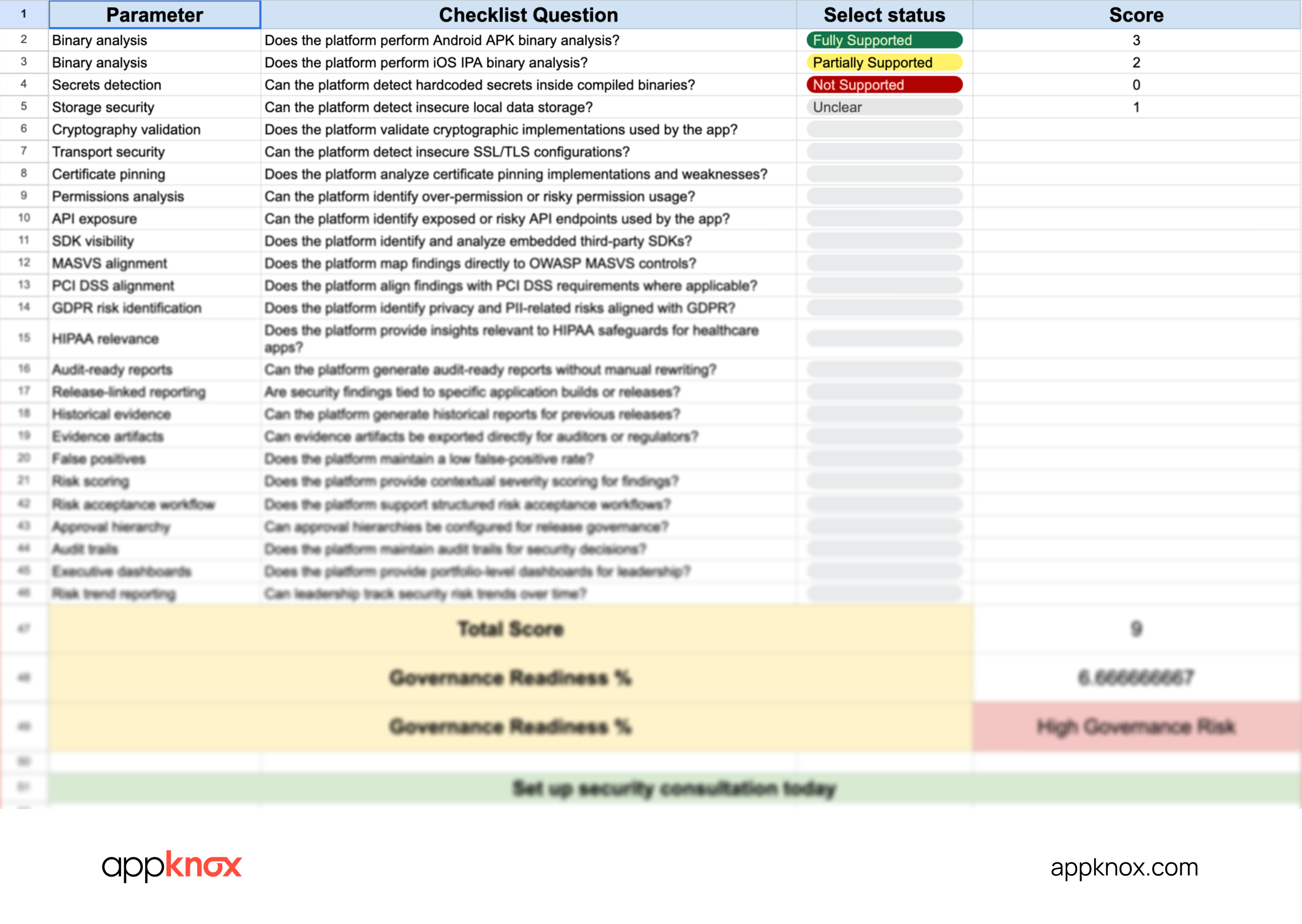
Download the full Mobile AppSec Evaluation Spreadsheet to score your platform and calculate your Governance Readiness %.
Mobile AppSec must account for compiled binary exposure, SDK opacity, distributed deployment, and app store governance. Web security tools primarily assess server-side code and centralized infrastructure. Mobile evaluation requires binary-level inspection and release traceability.
Most tools produce vulnerability findings but lack structured release traceability, documented risk acceptance, and compliance-mapped evidence. Regulators evaluate governance processes, not scan frequency.
No. Static analysis alone does not reflect compiled binary behavior, embedded secrets, or SDK data flows. Mobile security evaluation must include artifact-level and runtime-aligned inspection.
CISOs should evaluate:
Tool feature lists are insufficient without defensibility.
Release traceability links specific builds to validation results, documented risk acceptance, and approval records. This allows enterprises to demonstrate structured governance under audit.
The biggest mistake enterprises make when deciding on tools is over-indexing on detection volume and dashboard metrics, while under-evaluating governance alignment, signal quality, and traceability.
Mobile app security tools map findings to framework requirements, but true readiness depends on continuous validation and governance, not one-time testing.
Auditors look for evidence—validation results, approval decisions, and traceability tied to specific releases.
You can prove that your mobile app was secure at release time by maintaining build-level validation records, documented risk decisions, and timestamped approvals for every release.
Mobile app risk can be tracked across multiple applications through centralized visibility, consistent scoring frameworks, and lifecycle-based governance models.
Enterprise organizations typically choose platforms that demonstrate scalability, alignment with compliance requirements, and operational reliability across large app portfolios.
Cloud-based platforms with strong integrations and minimal setup requirements are typically easier to deploy across distributed teams.
Advanced mobile app security solutions use behavioral analysis and anomaly detection to identify patterns associated with automated or AI-driven attacks.
These attacks often mimic legitimate user behavior, making them difficult to detect through static rules. By focusing on deviations in usage patterns and API interactions, modern platforms can identify and respond to such threats more effectively.
Platforms that provide continuous monitoring help ensure that mobile applications remain aligned with security and compliance requirements even after release. They track changes in behavior, dependencies, and API interactions that may introduce new risks over time.
This enables organizations to maintain compliance not just at release, but throughout the application lifecycle.
Support quality becomes critical after onboarding, when teams begin operationalizing security.
Platforms with strong support typically offer:
Solutions like Appknox are often evaluated not just for product capabilities, but for how effectively they support teams in real-world environments, especially during critical security events.
Hackers never rest. Neither should your security!
Stay ahead of emerging threats, vulnerabilities, and best practices in mobile app security—delivered straight to your inbox.
 Exclusive insights. Zero fluff. Absolute security.
 Join the Appknox Security Insider Newsletter!


