BLOG
The Common Vulnerability Scoring System ( CVSS ) offers a procedure to assess the level of vulnerability the software possesses. Here's all you need to know

.png)


BLOG
 5 Mins Read
Given the large and growing number of cyber attacks that exploit software vulnerabilities, vulnerability management is critical. Misjudging the severity of an existing vulnerability can result in various unintended consequences.
Legal battles, financial losses, and reputational damage are all possible outcomes for a business. To combat today's modern cybersecurity challenges, it's critical to have a vulnerability management program in place.
As a company introduces new technology to the organization, the data and information must be secured. Recently, large corporations have faced an additional level of risk that interferes with their day-to-day operations. Specialists rely on the Common Vulnerability Scoring System (CVSS) for complete information security.
The Common Vulnerability Scoring System offers a procedure to assess the level of vulnerability the software possesses. Most cybersecurity professionals use the CVSS base score as a major factor to examine the severity of any weakness in the system.
The framework supports organizations to ensure confidentiality and integrity while protecting the data owned by the company. The system helps organizations prioritize software vulnerabilities on the basis of those that need immediate attention.
CVSS, introduced in 2005 by NIAC, is now owned and managed by the International Forum for Incident Response and Security Teams (FIRST). The scoring system has undergone many revisions since then, which is why we have three versions of CVSS that have been released to date.
FIRST designed the initial framework of CVSS and tested and refined its formulas for the upcoming versions. Let us take a look at each one of them.
Released by the US National Infrastructure Advisory Council (NIAP) in 2005, CVSS V1's objective was to design a standard for severely rating system vulnerabilities.
Due to the shortcomings found in CVSS V1, the development of CVSS V2 was initiated. It was released in 2007 as an improved version of CVSS V1. Its features included reduced inconsistencies and additional granularity, with true properties of the vulnerabilities being reflected regardless of the many types of vulnerabilities.
Well, CVSS V2 also had a few limitations, which demanded a few revisions, which resulted in the development of CVSS V3, which was released in 2015. This refined version had more advanced features, such as addressing issues of the privileges needed to exploit any vulnerability and opportunities for the attacker to tap into after the exploitation of the vulnerability.
Another version of CVSS V3 was released in June 2019 after certain revisions, i.e., CVSS V3.1.
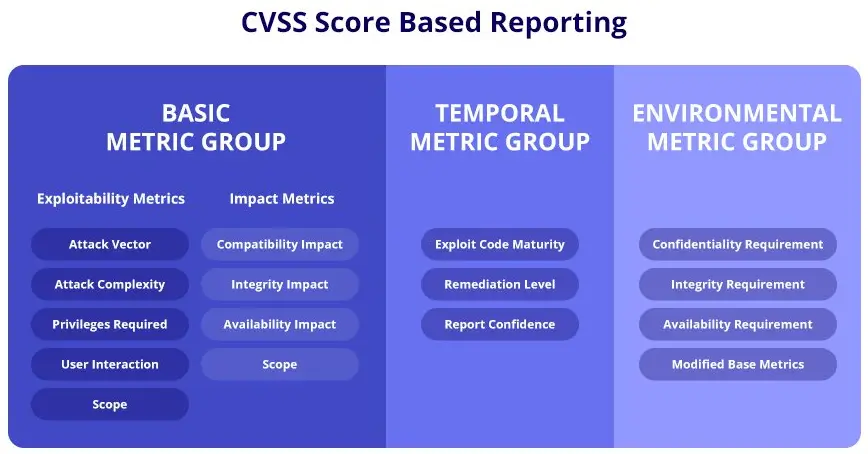
The CVSS score is created with three sets of metrics named base, temporal, and environmental. Below are details on each one of them.
The base metric group showcases the elements of the vulnerability. These elements stay unified across the environment of the user. It further includes other characteristics named exploitability, scope, and impact.
This metric deals with the means of ease and tech that are needed to exploit any vulnerability. The exploitability includes four subcomponents, namely attack, vector, attack complexity, and privileges required by the user interaction.
The scope indicates the possibility of a vulnerability in a component that impacts other components in the system. The score here is higher if the exploitation of any vulnerability enables the attacker to achieve successful access to all other aspects of the system.
The impact on the base metrics indicates the consequences of the attack. It is further divided into three impact metrics: confidentiality, integrity, and availability.
The temporal metrics refer to the elements of the vulnerability that keep evolving with time. However, it does not take into account the environment of different users. The sub-components here are named Exploit Code, Maturity, Remediation Level, and Report Confidence.
The environmental metrics refer to the elements of a vulnerability that consider the user's environment. Such metrics enable the organization to customize the base CVSS score based on the security requirements and the customization of the base metrics. It is further divided into security requirements and modified base metrics.
CVSS scoring begins with standardized base metrics: attack vector, complexity, privileges required, user interaction, scope, and impact on confidentiality, integrity, and availability. These inputs produce a numerical score that reflects theoretical severity.
However, in real security programs, calculation is only the first step. Scores must be reviewed alongside exploitability, application exposure, and environmental context to ensure accuracy.
At Appknox, CVSS scoring is:
Automatically calculated using industry-standard formulas
Reviewed for contextual accuracy in mobile and API environments
Mapped to application-specific risk, not just generic severity
This prevents teams from treating CVSS as a static number rather than a decision-support mechanism.
📌Key takeaway: CVSS scores are only useful when calculated consistently, reviewed carefully, and validated against a real-world context.
Security teams should always be able to trace why a vulnerability received a specific score. Detailed CVSS reports break down each metric contributing to the final score, allowing teams to validate assumptions and confirm relevance.
In Appknox reports, teams can review:
Individual CVSS vector components
Severity breakdown across releases
Historical scoring trends for recurring issues
This transparency is critical for audits, remediation planning, and stakeholder trust.
📌Key takeaway: Incorrect CVSS scores create false urgency, or worse, false confidence.
CVSS scores can become inaccurate when:
The affected component changes
Exploitability assumptions evolve
Environmental factors are not considered
When this happens, teams must be able to request recalculation and adjust prioritization accordingly. Appknox supports recalculation workflows that ensure updated scores reflect current risk, without losing historical traceability.
Mature teams don’t look at CVSS scores in reports; they use them to drive action. CVSS should feed directly into triage, remediation, and release decision-making.
With Appknox, CVSS scoring integrates into:
CI/CD security gates
Ticketing and remediation workflows
Risk dashboards for engineering and leadership
This ensures vulnerabilities are prioritized consistently across teams and environments.
📌Key takeaway: CVSS delivers value only when embedded into workflows, not reviewed in isolation.
Compliance frameworks such as PCI DSS, ISO 27001, and SOC 2 expect organizations to demonstrate risk-based vulnerability management. CVSS provides the scoring backbone for that justification, but only if applied consistently.
Appknox ensures CVSS scoring:
Is applied uniformly across assets
Is documented and auditable
Aligns with regulatory expectations for risk prioritization
This allows teams to show not just remediation activity, but rational, defensible decision-making during audits.
📌Key takeaway: Regulators don’t just ask what you fixed. They ask how you decided what mattered.
A CVSS scoring ranges between 0.0 and 10.0 (10.0 rated as the most severe). FIRST maps the CVSS scores to the ratings as mentioned below:
0.0 = None
0.1-3.9 = Low
4.0-6.9 = Medium
7.0-8.9 = High
9.0 - 10.0 = Critical
The CVSS scoring is measured on the basis of the combination of different characteristics. The sole requirement of sub-categorizing any vulnerability is the complexity of the elements of the base score. However, it is strongly advised that the reports must also include temporal metrics and environmental metrics for accurate analysis.
Good Read: What to Look for in a Mobile Security Assessment Report?
In the past, companies adopted their own procedures to score software vulnerabilities, but these methods did not include certain details about how the scores were measured. This created a problem with prioritizing the vulnerabilities, and this is when the US National Infrastructure Assurance Council (NIAC) developed CVSS to ease the system.
CVSS helps measure the severity of a vulnerability's impact on an IT environment. As CVSS is an open framework, organizations have complete access to the measuring tactics used to create the scores, enabling all others to clearly understand the differences among the vulnerability scores.
The software system makes it easier for the security department to consider and measure the impact of the vulnerabilities. It also helps organizations to meet the security requirements of numerous standards. For such reasons, CVSS is adopted by many organizations such as Oracle, Cisco, and Qualys. The software developers of these organizations use CVSS to prioritize security tests to make sure that severe vulnerabilities are eliminated.
Good read: Compliance Checks That Businesses Need To Follow
Appknox SAST, DAST, and API testing are the best ways to ensure your code is secure. VA tools identify and eliminate security vulnerabilities and software defects early on in development. That helps to ensure that your software is secure, reliable, and compliant.
Appknox VA helps you:
CVSS scoring is enabled by default in Appknox vulnerability assessments. Teams can confirm setup by reviewing scan configurations, CVSS vectors, and scoring outputs within assessment reports.
Yes. Appknox integrates CVSS scores into CI/CD pipelines, dashboards, and remediation workflows so teams can prioritize vulnerabilities consistently without changing how they work.
Appknox supports score review, recalculation, and contextual validation to ensure CVSS scores remain accurate as application environments and threat conditions evolve.
Hackers never rest. Neither should your security!
Stay ahead of emerging threats, vulnerabilities, and best practices in mobile app security—delivered straight to your inbox.
 Exclusive insights. Zero fluff. Absolute security.
 Join the Appknox Security Insider Newsletter!



.jpg?width=50&height=50&name=10606600_10204086667262761_7381430219125488912_n%20(1).jpg)
