
.png)



Appknox Adds Portfolio-Wide App Store Release Readiness to Its Mobile Security Platform
20th July, 2026: Appknox today announced the launch of Store Release Readiness, a new capability within its mobile application security platform designed to help teams identify potential app-store rejection risks before a build enters the formal submission process.
The module assesses successfully uploaded builds against relevant Apple App Store and Google Play submission requirements. It gives security, engineering, product, and release teams a shared view of issues that could affect store approval, including policy violations, privacy risks, compliance gaps, and configuration problems.
Store Release Readiness is available by default to all Appknox customers at no additional cost and is supported across both cloud and on-premise deployments.
App-store approval is not a formality
Publishing an application involves more than ensuring that the build is functional and secure.
Apple and Google evaluate applications against requirements that cover performance, privacy, permissions, data handling, design, functionality, developer declarations, and platform policies. A build can pass internal testing and still require further remediation before it is ready for store review.
The scale of app-store enforcement highlights the need for earlier visibility.
Google reported that it prevented more than 1.75 million policy-violating apps from being published on Google Play in 2025. It also prevented more than 255,000 apps from receiving excessive access to sensitive user data. Google says every app it publishes undergoes more than 10,000 safety checks, with checks continuing after publication.
Apple’s latest App Store Transparency Report provides additional context. In 2024, Apple reviewed approximately 7.77 million app submissions and rejected approximately 1.93 million—equivalent to nearly one in four submissions reviewed. Apple also reported that more than 295,000 submissions were approved after an earlier rejection, illustrating the additional review and resubmission cycles that can follow an initial rejection.
These figures are not directly comparable. Apple reports total submissions reviewed and rejected, including updates and repeat submissions, while Google reports policy-violating apps prevented from publication rather than an overall submission-rejection rate. Together, however, they demonstrate the breadth of the controls applied before applications reach users.
The release-readiness gap
For many organizations, the processes used to evaluate mobile applications remain fragmented. AppSec teams focus on vulnerabilities. QA teams validate functionality. Engineering teams prepare builds. Product and release teams manage the final submission to Apple or Google.
Checks related to app-store requirements may sit outside these workflows or appear only when the application reaches a store console. At that stage, unresolved issues can create another cycle of investigation, remediation, rebuilding, and resubmission.
Google has itself expanded the use of pre-review checks to surface potential problems before formal review. Its developer guidance says these checks are intended to help teams avoid common mistakes that may result in rejection. Examples include missing mandatory declarations, high crash rates, compatibility issues, improper use of permissions or credentials, and broken privacy policy links. Passing these preliminary checks does not guarantee approval because the formal review process is more comprehensive.
Store Release Readiness brings similar early-warning visibility into the existing Appknox workflow, allowing teams to investigate potential risks before beginning the store-submission process.
A portfolio-wide view of release risk
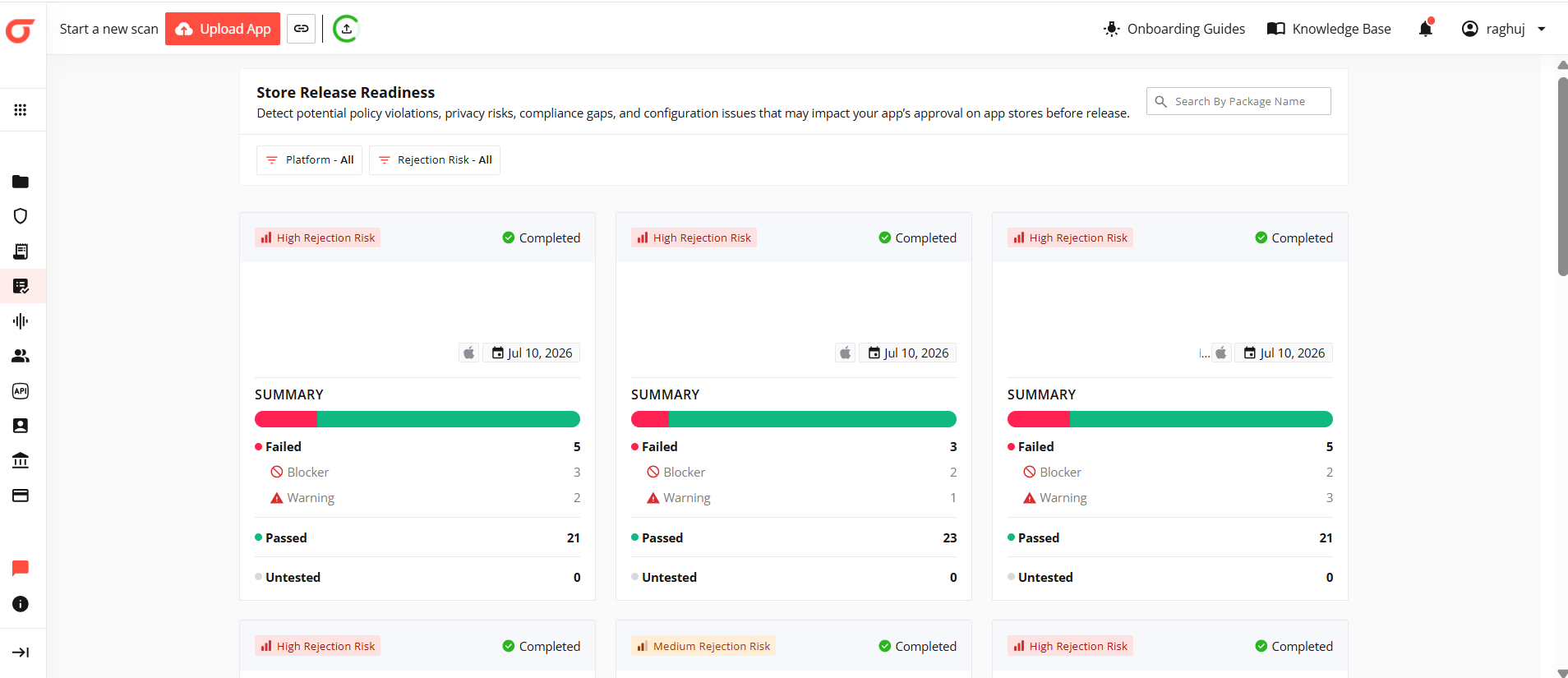
Store Release Readiness runs automatically when a build is uploaded to Appknox. No separate scan or additional workflow is required. Each assessed application receives an overall Release Rejection Risk rating of: High, Medium, and Low.
The portfolio view allows teams to search applications by package name and filter results by platform and rejection risk. This makes it possible to identify which applications or builds require the most immediate attention across a broader mobile application portfolio.
Rather than presenting every failed check as an undifferentiated finding, Store Release Readiness categorizes issues as:
Blockers
Issues with a greater likelihood of affecting the application’s ability to progress through store review.
Warnings
Issues that may create review concerns, require clarification, or contribute to release delays.
For each failed check, Appknox provides supporting evidence, the relevant store-policy reference, and actionable remediation guidance. Teams can also ignore findings that do not apply to their application, helping maintain a cleaner and more relevant readiness view.
Bringing release visibility into the AppSec workflow
Store Release Readiness expands the question that mobile application security platforms can help teams answer.
Traditional application security testing primarily focuses on whether a build contains vulnerabilities. Release teams must also understand whether the application could encounter store-policy or submission issues before it reaches Apple or Google for review.
By bringing these signals together, Appknox gives security and release stakeholders a common view of:
- Which applications carry the greatest potential rejection risk
- Which findings may block a release
- Which store requirement is associated with each issue
- What action is required to remediate it
- Whether the build’s readiness posture has improved over time
This is particularly relevant to enterprises managing multiple mobile applications, frequent releases, regional application variants, or tightly controlled launch schedules.
“A mobile application can be technically complete and security-tested, but still encounter delays because it does not meet an app store’s submission requirements. Store Release Readiness gives teams earlier visibility into potential blockers and brings security and release confidence into the same workflow. The objective is simple: help teams know what could affect approval before they submit the build,” said Raghunandan J, Product and R&D Head, Appknox.
Store Release Readiness is designed to help organizations reduce avoidable submission risk; it does not guarantee that Apple or Google will approve an application. Final approval remains subject to each store’s complete review process and policies.
Availability
Store Release Readiness is now:
- Available by default to all Appknox customers
- Included at no additional cost
- Supported in cloud and on-premise Appknox deployments
- Triggered automatically following a successful build upload
Existing customers can access the new module directly within the Appknox platform.
Know what could block your release before you submit.
About Appknox
Appknox is a mobile application security platform that helps enterprises identify, prioritize, and remediate security risks across their mobile application portfolios. The platform brings automated security testing, real-device dynamic analysis, API security, software supply chain visibility, and actionable remediation guidance into a single mobile AppSec workflow.
