
BLOG
Enterprises run 50+ security tools. Appknox doesn't add to that sprawl; it closes the gap your existing stack leaves open. Here's exactly where it fits.

.png)


BLOG
 13 Mins Read
Your stack has a SAST. A DAST. An SCA. A SIEM. And probably seven more tools your developers have quietly stopped reading alerts from.
None of them were built for mobile.
That's not a criticism. It's a fact about what those tools were designed to do. They were built for web applications, network infrastructure, and cloud environments, which were the priorities of a different era. Mobile apps came later. And the security tooling never fully caught up.
Here's what that looks like in practice: 85% of organizations increased their cybersecurity budgets this year. More than half of those security leaders still believe they aren't investing enough to manage risk (Wiz 2026 CISO Budget Benchmark). The average enterprise now runs 50 security tools, and 67% of security professionals say managing them is a significant hurdle (Cycode State of ASPM 2025).
More spending. More tools. Less confidence.
That is not a funding problem. It is a coverage architecture problem. You can have 50 tools and still have your mobile app, the surface attackers hit most, sitting entirely outside their scope.
Appknox is not tool number 51. It is the platform that closes the specific gap your existing stack leaves open. This blog shows you exactly where it fits, stage by stage, capability by capability.
Nearly half of CISOs say tool sprawl is actively holding back their security programs (Wiz 2026 CISO Budget Benchmark). That isn't because the tools are broken. It's because they were designed for a world where the application sat on a server you controlled. Mobile changed that equation entirely.
85% of organizations reported an increase in mobile attacks in 2025, a finding that held across all organization sizes, locations, and industries (Verizon 2025 Mobile Security Index). Most of those organizations had a security stack. Most had SAST, DAST, and SCA.
None of those tools covered the mobile surface.
|
Tool |
What it covers |
What it misses on mobile |
|
SAST |
Source code patterns |
Runtime behavior; binary vulnerabilities post-compilation |
|
DAST (web) |
HTTP endpoints, web flows |
Mobile-native call chains; on-device token behavior; certificate pinning |
|
SCA |
Direct dependency CVEs |
Transitive SDK dependencies; dynamic code loading |
|
WAF |
Network-level traffic |
Binary tampering; runtime hooking; on-device attacks |
|
Annual pentest |
Point-in-time logic |
API drift between releases; SDKs added post-test |
70% of CISOs say their existing tools aren't as effective as they could be at detecting breaches, specifically because of limited visibility (Gigamon CISO Insights, 2024).
Tools without mobile coverage don't just leave a gap. They create false confidence.
Not sure what your mobile app security stack should look like?
Start here first:The Best Tech Stack for Building Safe Apps
Some vendors propose adding a Runtime Application Self-Protection layer to the app. RASP detects and blocks threats at runtime. It wraps a protection layer around the binary after compilation.
What it doesn't do is fix the underlying vulnerability.
Putting RASP on a vulnerable app is like installing a security guard at a house's door while leaving the windows unlocked. The guard might stop the first intruder. The windows stay unlocked.
Appknox finds the unlocked windows before the app ships and fixes them. That is the difference between hardening the fence and securing the building's foundation. Both can coexist in a security program. However, they answer different questions.
"Fits into the stack" has a specific technical meaning for a CISO managing 50+ tools and a development team with zero appetite for new overhead.
|
Dimension |
What it means |
How Appknox delivers |
|
Pipeline fit |
Testing triggers automatically at the right build stage |
Native CI/CD: Azure Pipelines, Jenkins, CircleCI, Bitrise, GitHub Actions, GitLab CI, Bitbucket Pipelines, App Center Build, ArmorCode |
|
Workflow fit |
Findings go where developers already work |
Jira, Slack, ServiceNow — findings route into existing backlogs |
|
Team fit |
Single portfolio view for security teams |
One dashboard across all mobile apps, all findings, all compliance |
Appknox also offers a CLI for command-line automation and Public APIs for teams that need to build security testing into custom tooling or reporting workflows.
Adding Appknox does not mean your developers learn a new tool. It means your existing tools start producing mobile security signals they currently cannot generate.
See every integration that Appknox supports.
Check out: Appknox integrations
The DevOps manager sees security testing trigger automatically on every build in the same CI/CD workflow already running. No blocked releases. No handoffs. Security sign-off becomes a built-in pipeline stage rather than a downstream review.
The developer receives confirmed findings in Jira or Slack with proof of exploitability and a fix path already attached. No portal login. No security briefing required before they can act.
The security analyst gets a single dashboard across the entire mobile app portfolio. Every app. Every finding. Every compliance framework status. No aggregating reports from separate tools.
The compliance officer gets audit-ready evidence generated automatically with every scan, mapped to the compliance framework it affects, without having to chase the security team for documentation before an audit.
Appknox is the mobile DevSecOps layer most enterprises are missing. It shifts security left, as binary SAST and SBOM run on every commit, and it runs continuously through staging, with DAST on real devices.
However, it extends well beyond release, as Storeknox discovers every version of the app across stores, maintains a centralized inventory, and detects drift the moment an unauthorized build appears. Privacy Shield maps the full data privacy surface across every release, helping surface what the app collects, where data flows geographically, and whether those practices meet the regulatory obligations of every market the app serves.
The result is mobile security and compliance that runs at the pace of the development team. Not a quarterly review. A continuous loop alongside every sprint.
Appknox maps every finding to the compliance framework it violates automatically, as part of every scan. GDPR, PCI-DSS, HIPAA, NIST, CWE, OWASP Mobile Top 10 2024, OWASP API Top 10 2023, and MASVS are all covered. Compliance documentation generates itself. It doesn't get assembled manually before an audit.
Learn about every compliance framework Appknox supports.
Check out: Compliance at Appknox
These apps operate at the intersection of multiple compliance obligations.
A manual quarterly pentest satisfies none of these.
Appknox's continuous automated testing produces PCI-DSS, GDPR, and OWASP-mapped audit evidence on every scan for every market simultaneously.
These mobile apps face a compliance requirement that SAST cannot meet. HIPAA requires protecting ePHI in the stateful API flows that connect the app to backend health record systems — a runtime behavior that only surfaces during authenticated DAST on real devices.
An app that passes static analysis can still leak patient appointment data through a specific navigation flow.
Appknox's real-device DAST catches this class of vulnerability. PTaaS provides the manually certified penetration testing evidence that regulators increasingly require beyond automated scan reports. HIPAA also mandates a 6-year audit log retention period, which Appknox generates automatically for each scan.
Privacy Shield addresses the data minimization and consent requirements that HIPAA and GDPR impose on health app data collection, bringing to light every data point the app gathers, including from third-party SDKs, against the declared privacy policy and applicable regulatory obligations.
E-commerce apps carry the highest SDK count of any industry segment as they have analytics frameworks, loyalty SDKs, payment processors, and advertising networks. The Verizon 2025 Data Breach Investigations Report found that third-party involvement in breaches doubled to 30% in one year.
Appknox's SBOM surfaces the full dependency chain on every build, catching vulnerable SDK versions before production. Storeknox monitors for repackaged fake versions of the app on third-party stores — a specific vector for loyalty point theft and payment credential fraud that the CI/CD pipeline cannot see.
These heavily regulated mobile apps require binary testing without source code access, which matters when source code is classified or controlled, and MASVS compliance mapping to satisfy digital government security frameworks.
Appknox is deployed across government agencies in Southeast Asia, the Middle East, and South Asia, where mobile security compliance is a legal obligation.
|
Capability |
Pipeline stage |
Gap it closes |
Who uses it |
|
Automated VA (SAST, DAST, API) |
Pre-release testing on every build |
Binary and runtime, where source code scanners never reach |
Security team, DevOps, developers |
|
KnoxIQ |
Between detection and developer routing |
Noise: the 95–98% of alerts that don't require action |
Security team, developers, CISO |
|
SBOM |
Supply chain visibility layer on every build |
Hidden dependencies: the libraries your SDKs depend on |
Security, compliance, procurement |
|
PTaaS |
Deep logic testing, alongside automation |
Business logic: the class only human reasoning finds |
Security team, compliance, CISO |
|
Storeknox |
Post-deployment outside the pipeline |
Distribution surface: fake apps your CI/CD can't see |
Security, brand, legal, CISO |
|
Privacy Shield |
Pre-release and continuous across the full compliance lifecycle |
Data privacy surface: what the app collects, where it flows by geography, and whether it meets GDPR, CCPA, DPDP, and applicable regional regulations |
Security, compliance, legal, privacy officer |
Most security tools test your source code. Appknox tests your binary, i.e., the compiled artifact that actually ships to users. Attackers don't reverse-engineer your GitHub repository. They reverse-engineer your APK or IPA. The binary is what they work with. It should be what you test against.
The OWASP Mobile Application Security Testing Guide (MASTG) requires authenticated test sessions to properly evaluate authentication flows, session management, sensitive data handling, and API authorization, as these are the vulnerability categories most commonly exploited in production mobile apps. An unauthenticated scan cannot reach these surfaces. It tests only what is visible before login (OWASP MASTG).
Appknox runs authenticated DAST on real iOS and Android devices, not emulators, which means it sees what an attacker would see, not what a clean lab environment shows. The scan triggers on every build and delivers results within 60 minutes.
See how Appknox’s automated VA works.
Check out: Automated vulnerability assessment.
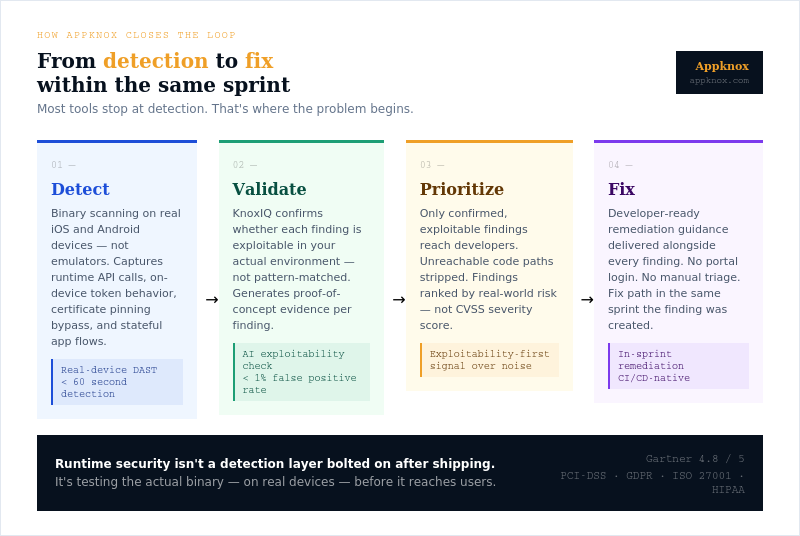
95% of AppSec alerts don't require action (OX Security, 2025, 101 million findings). KnoxIQ validates every finding before it reaches a developer,
A CVSS score tells you what looks dangerous. KnoxIQ tells you what is dangerous in your app, right now.
Learn how KnoxIQ eliminates exploitability guesswork.
See KnoxIQ
SDK-based attacks increased 40% in 2025 (Corellium, 2026). 87% of commercial codebases contain at least one known open source vulnerability, and 78% contain high-risk vulnerabilities, including codebases in the Internet and Mobile Apps sector (Black Duck OSSRA Report 2026).
Your SCA tool audits the libraries you declared. Appknox's SBOM surfaces the ones you didn't know you had, including transitive dependencies that no documentation ever lists.
Learn more about Appknox SBOM.
Check out: Our binary-based SBOM
Automated testing finds what it was programmed to find. Manual penetration testing finds what an attacker would try. Business logic flaws, such as authentication bypasses, authorization gaps, and multi-step transaction exploits, require human reasoning to discover.
Appknox's PTaaS delivers certified security researchers scoped to your specific application, with findings routed into the same workflow as automated results. Not in a PDF that sits in a shared drive for 60 days.
Explore Appknox’s manual pen testing service.
See: Appknox PTaas
Your pipeline ends at release. The threat does not.
Discovery. Storeknox continuously scans official and third-party app stores to surface every publicly accessible version of your app, including builds your team never published. Unauthorized clones, repackaged binaries, and impersonator apps appear in the inventory the moment they are detected, giving your security and brand teams visibility they otherwise could not obtain.
Centralized inventory. Every discovered app version, authorized and unauthorized, is tracked in a single inventory organized by store, region, version, and risk level. Security, legal, and brand teams work from a single source of truth rather than managing separate store-by-store searches. The inventory updates continuously, not on a quarterly audit cycle.
Drift detection. Storeknox compares every discovered build against your authorized release. Any deviation, such as injected code, modified permissions, repackaged binary, or version mismatch, triggers an alert with the specific delta identified. Guided takedown initiates the moment an unauthorized build is confirmed, shortening the window between exposure and removal.
Explore Appknox’s manual pen testing service.
See: Appknox PTaas
Security testing asks: Can this app be compromised? Privacy Shield answers a different question: what data an app collects, where it flows, and whether it complies with the regulations that apply in every market it serves.
GDPR fines do not require a breach to trigger. Improper collection, missing consent, and unauthorized cross-border data transfers are all independent enforcement events.
|
Capability |
What it surfaces |
|
Privacy surface mapping |
Every data collection point in the binary, first-party and SDK, that is mapped against the declared privacy policy. The gap between what the app says it collects and what it actually collects is where enforcement begins. |
|
Geo-risk exposure |
Where user data flows geographically. An app routing EU user data through servers in a non-GDPR jurisdiction creates obligations that no security scanner flags. |
|
Regulatory compliance mapping |
Posture against GDPR, CCPA/CPRA, DPDP (India), and PDPA (Southeast Asia): a compliance view legal and privacy teams can act on directly. |
Appknox scans trigger automatically on every build. The full scan completes within 60 minutes and runs asynchronously, so it does not block the pipeline.
Critical findings can be configured to gate deployment; all other findings route directly to developer queues without interrupting the release cycle. What creates delays is the current alternative:
Before Appknox, Singapore Airlines' previous security contractors had a 30-day turnaround. After, they were shipping fully secured apps in under a week.
Yes. Appknox tests the compiled binary, the APK or IPA, not the source code framework.
A React Native app, a Flutter app, a Kotlin app, and a Swift app all produce a binary that Appknox analyses in the same way. Development teams don't need to change their technology choices to get coverage.
The loop closes within the sprint. Not in a quarterly review.
[How Appknox helped 3 global companies transform their mobile app security]
A global oil & gas leader needed to scale security testing across a growing app portfolio without slowing release cycles. Appknox was integrated directly into their existing SDLC. Security sign-off stopped being a bottleneck and started being a built-in step. Security processes ran 80% faster. Releases stopped waiting.
Find out how security stopped blocking releases for this oil & gas leader→
An iconic British retailer was spending an excessive amount of time on manual security audits, thus slowing release velocity and straining collaboration between security and development. Appknox automated the audit process and delivered continuous coverage between releases. Audit time dropped by 80%. Release velocity increased.
Learn how Appknox ensured 80% less audit time with zero workflow disruption →
The largest airline in Southeast Asia manages 120+ mobile applications. Credential stuffing attacks were compromising up to 1,000 customer accounts per day.
Credential abuse is the leading breach vector globally, driving 22% of all breaches in 2025.
Their previous vendors had a 7–8% false-positive rate and 30-day pentest turnarounds at 4x the cost.
Appknox replaced that model. 5,000 security issues closed. 10 compliance issues resolved. Attacks eliminated. $500,000 saved in a year. Payback period: 7 months versus the 12-month industry average.
"Appknox acts as the second layer of security testing on top of our internal verification and testing process." — Taryar W, Senior Security Researcher, Singapore Airlines
1,000 account takeovers a day. Then zero. Check out our case study on the largest airline in SEA →
Can you name every mobile application in production right now, including internal tools, partner apps, and white-labelled versions?
If not, your attack surface is larger than your security program knows.
Are your mobile app binaries tested for security after compilation, not just at the source code level?
Source code and binary are not the same artifact. Attackers work with the binary.
Do you have a complete inventory of every third-party library inside your mobile apps, including the libraries that those libraries depend on?
In April 2026, a single vulnerable third-party SDK exposed over 50 million Android app installations to attack (Microsoft Security Research, April 2026). If you can't see every dependence, you can't secure it.
How often do your mobile apps release? How often are they security tested? If the second number is lower than the first, vulnerabilities are accumulating.
Every release without a security gate is an untested attack surface reaching your users.
Do you have visibility into what happens to your app after it ships, including unauthorized versions under your brand?
Your pipeline ends at release. The threat doesn't.
When a security finding reaches a developer, how long does it take before they act? If the answer involves switching tools or logging into portals, your remediation velocity is determined by workflow friction, not vulnerability severity.
The bottleneck in most security programs is not detection. It's the distance between finding and fixing.
It is the platform that closes the gap your stack already has.
Your existing tools are doing their job. They were just never designed to cover mobile applications, but also the following:
Every Appknox capability maps to a specific gap at a specific stage. Automated VA at the build stage. SBOM at the supply chain stage. PTaaS at the deep logic stage. Storeknox at the post-deployment stage. Privacy Shield across the compliance dimension for privacy surface mapping, geo-risk exposure, and regulatory alignment. KnoxIQ at the validation and prioritization stage.
Nothing changes for your developers. Everything changes for your mobile security coverage.
See how Appknox fits into your stack.
No. Appknox complements your existing stack. Your SAST and DAST tools cover source code and web application flows. Appknox covers the mobile-specific surface that those tools weren't designed to test: the binary, the runtime on real devices, the mobile-native API call patterns, and the SDK supply chain.
Natively. Appknox supports Azure Pipelines, Jenkins, CircleCI, App Center Build, Bitbucket Pipelines, Bitrise, GitHub Actions, GitLab CI, and ArmorCode. Security testing triggers automatically on every build. Findings route into Jira, Slack, and ServiceNow. Programmatic access is available via the Appknox CLI and Public APIs.
Get full integration details at appknox.com/integrations →
A standard scanner detects and reports findings. KnoxIQ validates them. Every finding passes through KnoxIQ before it reaches a developer, thereby confirming exploitability in your specific environment, stripping unreachable code paths, generating proof-of-concept evidence, and attaching a fix path.
Appknox's false positive rate is under 1%.
Penetration testing secures the app before it ships. Storeknox monitors what happens after.
A repackaged version of your app can appear on a third-party store the day after your most recent pentest. Your pentest has no visibility into that. Storeknox does.
RASP detects and blocks threats at runtime. It does not fix the underlying vulnerability. Appknox finds and fixes structural weaknesses before the app ships. RASP hardens the fence. Appknox fixes the building. Both can coexist because they answer different questions.
Appknox maps findings to GDPR, PCI-DSS, HIPAA, NIST, CWE, OWASP Mobile Top 10 2024, OWASP API Top 10 2023, and MASVS. Appknox also covers regional requirements, including RBI (India), MAS (Singapore), SAMA/PDPL (Saudi Arabia), and DORA (EU). Compliance evidence is generated automatically on every scan.
See every compliance framework at appknox.com/compliance →
Appknox handles a large portfolio of mobile apps through a single dashboard with visibility across the entire portfolio, every app, every finding, every compliance status, without switching between tools. Testing scales automatically. Adding a new app means adding it to the dashboard and the CI/CD pipeline. No new workflow for developers.
Hackers never rest. Neither should your security!
Stay ahead of emerging threats, vulnerabilities, and best practices in mobile app security—delivered straight to your inbox.
 Exclusive insights. Zero fluff. Absolute security.
 Join the Appknox Security Insider Newsletter!


