
.png)


BLOG
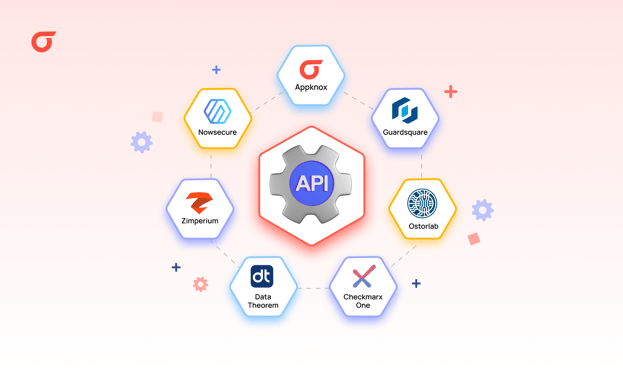
API security testing in CI/CD is not endpoint validation. Appknox, NowSecure, Guardsquare, and 4 more tools compared for mobile-first API security.
BLOG
 16 Mins Read
Your pipeline has an API testing stage. Your scanner runs on every build. A finding list comes back clean.
And then something gets exploited in production that your pipeline ran past 47 times without flagging.
Here's what happened: endpoint validation passed. Security didn't. They are not the same thing.
Here's what that box doesn't capture: APIs don't fail in clean test environments. They fail in usage under real sessions, through real application flows, and on real devices, behaving in ways your test scripts never modeled. And when those APIs are consumed by mobile applications, the gap between what your pipeline tests and what attackers actually do grows into something categorically different.
99% of organizations experienced API security issues in the past 12 months. More than half (55%) slowed the rollout of a new application because of API security concerns (Salt Labs State of API Security Report, Q1 2025). That's not a tooling problem. That's a framing problem. Teams are testing the wrong thing and calling it security.
This guide is designed for security engineers, DevSecOps leads, and engineering managers who need to close that gap, particularly in environments where mobile applications are involved.
For the complete breakdown of mobile API security testing tools,
See our pillar guide: Top API Security Testing Tools for Mobile Apps
Walk into an engineering team that has "API security in the pipeline," and you will typically find the same setup. A developer pushes code. The pipeline kicks off. An API testing stage runs — endpoints get hit, responses get checked, schemas get validated. If everything passes, the build moves forward.
For functional testing, this works well.
For security, it doesn't because security doesn't behave like functionality.
|
Question |
Functional API test |
Security API test |
|
Did the endpoint return the right response? |
✓ Answers this |
— Does not care |
|
Can this API be abused through token replay? |
— Does not model |
✓ Tests this |
|
What happens if authentication is bypassed? |
— Does not test |
✓ Tests this |
|
How does the API behave in stateful sequences? |
— Does not simulate |
✓ Tests this |
|
Are there shadow APIs not in the documentation? |
— Does not discover |
✓ Discovers these |
These are not the same question. And most CI/CD pipelines are built to answer only the first one.
|
Pipeline stage |
What happens |
What gets missed |
|
Code commit |
Developer pushes code |
— |
|
Build trigger |
Pipeline starts |
— |
|
API test stage |
Endpoints validated, schemas checked |
Runtime behavior, behavioral context |
|
Results |
Findings generated |
Exploitability signal, mobile-specific attack paths |
|
Deploy |
App released |
Post-deployment API drift, shadow endpoint exposure |
Key takeaway: Endpoint-level detection is necessary. It is not sufficient. The gap it leaves is exactly where mobile API vulnerabilities live.
If your APIs are consumed by mobile clients, the problem is not just bigger. It is structurally different.
Mobile-specific features, such as sandboxing, platform APIs, and runtime behaviors, make mobile security testing different from traditional web or desktop testing and require dedicated tools.
Here are the five specific dimensions where mobile breaks generic API testing:
Mobile apps store tokens locally. Sessions persist across interactions in ways server-side tests don't replicate.
When token validation is improperly handled — a token accepted past its expiry, a refresh token scope that's too broad, an on-device credential store that's readable under certain device conditions — the vulnerability only manifests at runtime, not in a pipeline test against a clean build.
Web applications push API updates in sync with the frontend. Mobile users don't always update immediately. So backends support older API versions for months or years while web apps push UI and API updates in sync.
The result: multiple live app versions coexist simultaneously, each with its own API surface.
In mobile apps, APIs are often triggered through specific user flows — deep links, multi-step interactions, and screen transitions. The attack surface only opens when those flows execute in sequence.
A single endpoint tested in isolation behaves correctly. The same endpoint, when called after a specific sequence of prior interactions, may expose a business logic flaw that no static test script can reach.
Web apps make API requests when users interact with the browser. Mobile apps sync data in the background, retry failed requests after connectivity returns, and queue requests when offline.
This creates request patterns that rate limiting doesn't catch and that your CI/CD test suite never generates. These are the patterns attackers specifically exploit for credential stuffing, data scraping, and session abuse.
Apps enforce SSL pinning during normal operation. Attackers strip it at runtime. When pinning is gone, APIs behave differently: vulnerabilities obscured by the encrypted channel become visible.
A CI/CD test running against a clean build sees the pinned behavior. An attacker sees the unpinned one. Platform differences compound this: mobile often gets compressed, minimal API responses, while web receives more verbose data; auth flows differ, with mobile typically using OAuth2 with refresh tokens while web relies on session cookies.
Key takeaway: Generic API security testing was designed for web environments. Mobile API security requires testing the full behavioral context — runtime conditions, stateful flows, version coexistence, and platform-specific authentication — that generic tools don't model.
For a deeper breakdown of why mobile API security is important,
Most security teams are not failing because they lack tools that find vulnerabilities. They are failing because they are buried in findings they cannot act on.
Only 15% of organizations expressed strong confidence in the accuracy of their API inventories, while 34% admitted they lack visibility into sensitive data exposure through APIs (Salt Labs, Q1 2025). The inventory problem and the prioritization problem are connected, as when you don't know what you have, you can't credibly triage what's at risk.
80% of API attack attempts in Salt Labs' Q1 2025 research align with the OWASP API Security Top 10, with 54% targeting security misconfigurations (API8) and 27% targeting broken object-level authorization (API1).
Attackers concentrate on specific, high-probability attack classes. A mature prioritization model concentrates defensive effort in the same way.
A scanner surfacing 400 issues per sprint creates a prioritization crisis that:
The question most teams are asking: How do we test APIs in our CI/CD pipeline?
However, the right question should be: How do APIs behave inside real applications, under real-world conditions, and which of those behaviors can actually be exploited?
That shift determines what you instrument, what you surface to developers, and what actually gets fixed.
Security that lives only at the endpoint level is detection. Security that understands behavior, validates exploitability, and connects to remediation is a system.
The teams that have closed the mobile API security gap in their pipelines have made specific structural choices about how API testing integrates with their build process.
None of these are tool decisions first. They are pipeline design decisions.
These are two separate stages. One validates that APIs return correct responses. The other validates how those APIs can be abused, through token replay, sequenced calls, state manipulation, and authentication bypass.
Combining them into a single stage means that security testing inherits the assumptions of functional testing. Those assumptions are exactly what attackers exploit.
Shadow APIs appear when mobile apps ship new versions or backend teams push uncoordinated changes. A discovery scan that runs quarterly misses the endpoint that shipped two sprints ago without authentication.
Mature programs run API discovery on every build cycle, against live mobile traffic, not documentation.
Multiple live app versions mean multiple active API surfaces.
Teams that track which endpoints are still being called by legacy app versions, and by how many users, can make deliberate decisions about when to retire them. Teams that don't are carrying an attack surface they don't know exists.
The question is not whether a finding exists. It is about whether the finding can be triggered in the specific production environment, given the app version, device conditions, and actual API behavior.
Teams that gate on confirmed exploitability rather than raw finding count dramatically reduce the triage overhead that causes most mobile security programs to stall.
A finding identified during a quarterly security review will not be fixed in the sprint in which it was created. A finding that arrives in the PR comment or CI gate, with a confirmed exploit path and a fix suggestion, will be fixed before the code ships.
The pipeline architecture determines whether security is embedded in the velocity or adjacent to it.
For a practical checklist on building secure and robust APIs,
A useful lens for this comparison could be: think about what a complete mobile app security program for an enterprise actually needs. It needs static analysis, dynamic testing on real devices, API security validation, binary scanning, manual penetration testing, exploitability confirmation, compliance mapping, shadow API discovery, and developer-ready remediation; all integrated into the CI/CD pipeline without adding a separate workflow.
Appknox covers all of these for mobile. The tools below each cover a meaningful subset, and every tool in this comparison has genuine mobile credentials.
The question for your team is which gaps matter in your environment.
For enterprises managing mobile app portfolios, Appknox is purpose-built to address the problem that generic API security tools quietly sidestep: APIs in mobile applications don't behave the way test scripts simulate.
Mobile APIs exist within applications with on-device token storage, certificate pinning, deep-link triggers, navigation-dependent call chains, and stateful sequences that only create exploitable conditions when combined.
Generic scanners test endpoints in isolation. Appknox tests how those endpoints behave within the application, where attacks actually occur.
Appknox is an all-in-one mobile app security platform.
For enterprises managing mobile app portfolios, it covers everything a mature mobile security program needs in a single integrated tool:
|
Capability |
Appknox |
|
SAST — static code analysis |
✓ |
|
DAST — on real iOS and Android devices |
✓ |
|
API security testing — mobile-native call patterns |
✓ |
|
Binary analysis — testing what was actually shipped |
✓ |
|
Shadow API discovery — from live mobile traffic |
✓ |
|
Exploitability validation (KnoxIQ) |
✓ |
|
Manual penetration testing |
✓ |
|
CI/CD-native integration |
✓ |
|
Developer-ready remediation guidance |
✓ |
|
Compliance: PCI-DSS, GDPR, ISO 27001, HIPAA, MASTG, MASVS, OWASP |
✓ |
|
Usage-based pricing |
✓ |
Certificate pinning bypass scenarios, on-device token behavior, and runtime authentication failures only surface under real hardware conditions.
Appknox runs DAST on real iOS and Android devices to get findings that reflect actual attack conditions, not simulated ones.
Most enterprise security teams are not failing to find vulnerabilities — they are failing to act on them because they cannot tell which ones are real. The false positive rate is the ratio between findings that deserve a developer's time and findings that steal it. At sub-1%, almost every finding that lands in a developer's workflow is a confirmed, exploitable issue. At 30% — closer to the industry average — nearly a third of every developer's security workload is generated by the scanner's own inaccuracy. That is not a security problem. It is a trust problem. And trust is the only mechanism that converts findings into fixes.
Appknox's AI layer confirms which findings can actually be triggered in your specific environment, generates proof-of-concept evidence, and delivers developer-ready remediation guidance. Findings arrive in the sprint they're relevant in, not in a PDF three days later.
Your pipeline generates findings. KnoxIQ tells you which ones can actually be exploited, and exactly how to fix them.
4.8/5
Enterprises with large or growing mobile app portfolios where API security has to scale across teams, apps, and release cycles, and where the cost of a missed runtime vulnerability in production is high.
Checkmarx One has expanded significantly beyond its SAST roots. It now covers SAST, SCA, API security, DAST, container security, IaC, and secrets detection under a single interface, with API discovery from source code, including shadow and zombie API identification.
Checkmarx DAST supports REST, SOAP, and gRPC APIs in live environments and consolidates findings with SAST results via its Application Security Posture Management layer. It was recognized as a Leader in the Forrester Wave for SAST in Q3 2025.
|
Capability |
Checkmarx One |
|
SAST — static code analysis |
✓ Excellent |
|
SCA — dependency scanning |
✓ |
|
API discovery from source code |
✓ |
|
DAST — mobile runtime on real devices |
Partial. Primarily web-oriented |
|
Binary analysis |
— |
|
Exploitability validation |
Partial. ASPM correlation |
|
Manual penetration testing |
Not a primary offering |
|
Mobile-specific API behavior testing |
Partial. Mobile DAST available, but less specialized than dedicated mobile tools |
|
Compliance tooling |
✓ |
As Gartner reviewers note, the built-in rules for mobile yield primarily low-severity findings, indicating that mobile-specific issue detection is less mature than its web and static analysis capabilities.
For teams where SAST and broad AppSec coverage are the primary need and mobile security is one component of a larger program, Checkmarx One is a strong fit. For teams where mobile is the primary application type, the depth of mobile-specific coverage warrants careful evaluation.
Large enterprises running mature DevSecOps programs where SAST is central to the security workflow and consolidated platform coverage is the priority.
Data Theorem was ranked #1 for both the Cloud-Native Use Case and API Security capabilities in the 2025 Gartner Critical Capabilities for Application Security Testing report, describing it as a strong fit for organizations seeking single-vendor coverage across application types.
Its platform covers the full software lifecycle: API Secure discovers and tests backend APIs for risks, including insecure data exposure and broken object-level access. Mobile Protect provides real-time telemetry and active defense within mobile apps.
Data Theorem takes a full-stack approach that includes static analysis, dynamic testing, behavioral analysis, and a runtime protection SDK (Mobile Protect) that provides active defense for deployed apps.
|
Capability |
Data Theorem |
|
SAST — static code analysis |
✓ |
|
DAST — mobile and API |
✓ |
|
Runtime protection SDK (Mobile Protect) |
✓ |
|
API discovery across multi-cloud |
✓ |
|
Exploitability validation |
Partial — auto-triage |
|
Manual penetration testing |
— |
|
Shadow API discovery |
✓ |
|
CI/CD integration |
✓ |
|
Compliance tooling |
✓ |
Data Theorem's strength lies in its breadth across application types, mobile, web, and cloud-native applications, all on one platform.
Where it concentrates differently from a mobile-first tool is in the depth of mobile-specific runtime analysis: the platform is designed to serve diverse portfolios, which means the mobile-specific behavioral depth — how exactly a vulnerability is triggered through a specific mobile app flow on a real device — is part of a broader offering rather than its primary focus.
Enterprises managing diverse application portfolios across mobile, web, and cloud who need broad unified coverage, especially in regulated industries where auditability across all app types matters.
Ostorlab combines SAST, DAST, SCA, and API testing for mobile (iOS and Android) and web, as well as attack surface testing, with CI/CD integration that surfaces findings inline in pull requests at the exact code location.
In November 2025, Ostorlab launched an AI Pentesting Engine for Mobile Applications. The engine maps complex app behaviors, navigates authentication flows under real-world session constraints, and validates whether each issue is genuinely exploitable, generating proof-of-concept evidence for each finding and producing a concise, verified list of issues with no sprawling reports and no guesswork.
|
Capability |
Ostorlab |
|
SAST — static code analysis |
✓ |
|
DAST — mobile and API |
✓ |
|
AI Pentesting Engine with PoC validation |
✓ |
|
CI/CD-native (GitHub, Jira, ServiceNow) |
✓ |
|
Real-device testing at enterprise scale |
Partial |
|
Manual penetration testing |
— |
|
Enterprise compliance reporting |
Developing |
|
Established enterprise support tier |
Developing |
Ostorlab is an actively evolving platform. Its AI Pentesting Engine, launched in late 2025, represents genuine capability.
Teams evaluating it for enterprise use should assess the maturity of compliance reporting and enterprise support tiers, which are more established in platforms with longer enterprise track records.
Mid-market teams prioritizing automation, continuous scanning, and CI/CD integration, particularly those who want exploitability validation built in.
Guardsquare is a mobile-first security platform trusted by more than 900 customers worldwide. It is a multi-product suite covering mobile app security for Android and iOS, built around four integrated products: AppSweep for security testing, DexGuard for Android app protection, iXGuard for iOS app protection, and ThreatCast for post-release threat monitoring.
Its primary orientation is protection and hardening — code obfuscation, tamper detection, and RASP — with security testing (AppSweep) as an integrated component.
AppSweep performs static and interactive analysis of iOS and Android apps, aligns findings with OWASP MASVS, and integrates directly into CI/CD pipelines, including GitHub Actions, Fastlane, Bitrise, and Jenkins.
What it covers
|
Capability |
Guardsquare |
|
SAST — static code analysis (AppSweep) |
✓ |
|
DAST — on real iOS and Android devices |
Partial. Static and interactive analysis; not runtime DAST on real devices |
|
Binary analysis |
✓ |
|
Code obfuscation and hardening |
✓ Core strength — DexGuard / iXGuard |
|
RASP — Runtime Application Self-Protection |
✓ Built into DexGuard and iXGuard |
|
Mobile-native API behavior testing |
Partial |
|
Shadow API discovery |
— |
|
Exploitability validation |
— |
|
Post-release threat monitoring (ThreatCast) |
✓ |
|
Manual penetration testing |
— |
|
CI/CD integration |
✓ Jenkins, GitHub Actions, Fastlane, Bitrise |
|
OWASP MASVS compliance alignment |
✓ |
Guardsquare's differentiated capability is protection depth: its polymorphic obfuscation engine — control-flow randomization plus name and string encryption that varies build to build — makes it the reference standard for teams that need to harden apps against reverse engineering.
For teams whose primary needs are security testing, exploitability validation, and CI/CD-integrated API security analysis, AppSweep performs well in static analysis, but the platform's testing depth is narrower than its protection depth.
The RASP capability is worth noting specifically: DexGuard and iXGuard include built-in RASP, an active runtime defense layered onto the app after compilation.
Enterprises with a strong need for code protection, obfuscation, and RASP alongside security testing, particularly in financial services, gaming, and streaming, where intellectual property protection and tamper resistance are as important as vulnerability detection.
With over a decade of mobile AppSec innovation, NowSecure delivers an integrated platform for DAST, SAST, IAST, and API security testing aligned with OWASP MASVS, NIAP, ADA MASA, and international standards.
The tool’s dynamic testing reveals how a mobile app behaves at runtime and provides the only practical way to uncover many of the most dangerous vulnerabilities, data leaks, and supply chain risks, i.e., the issues that typically surface only after authentication, when real users interact with sensitive data, privileged workflows, third-party SDKs, and backend APIs that static testing cannot meaningfully assess.
|
Capability |
NowSecure |
|
SAST, DAST, IAST — iOS and Android |
✓ |
|
API security testing |
✓ Mobile-focused |
|
AI-Navigator — authenticated DAST automation |
✓ Launched Feb 2026 |
|
Dynamic SBOM generation |
✓ |
|
Privacy analysis (GDPR, CCPA, HIPAA) |
✓ Core strength |
|
Real-device testing |
✓ |
|
CI/CD integration (GitHub, Azure DevOps, Jenkins, Bitrise) |
✓ |
|
Manual penetration testing (PTaaS) |
✓ |
|
OWASP MASVS, NIAP, ADA MASA compliance |
✓ |
|
Exploitability validation with fix guidance |
Partial |
|
Shadow API discovery |
Partial |
NowSecure's differentiated strengths are privacy analysis depth and compliance validation — mapping exactly what user data gets collected, where it goes, and whether it's encrypted, with flags for GDPR, CCPA, HIPAA compliance gaps alongside security findings. It is also the authorized lab for Google's App Defense Alliance MASA program.
Enterprises in regulated industries — telecoms, financial services, healthcare — where privacy compliance validation and MASA/NIAP certification are as important as security testing, and where authenticated DAST coverage is a priority.
Zimperium is a mobile-first security company covering both device threat defense (MTD) and application security testing (MAST) through its two product lines: zScan for automated app security testing and MAPS (Mobile Application Protection Suite) for runtime protection and hardening.
zScan runs three types of analysis: SAST to examine decompiled code for security flaws and insecure API usage; DAST to simulate runtime behavior and detect vulnerabilities during execution; and IAST to combine static and dynamic testing under realistic runtime conditions. zScan also adds mobile SBOM workflows.
What it covers
|
Capability |
Zimperium |
|
SAST, DAST, IAST (zScan) |
✓ |
|
Binary analysis |
✓ |
|
Mobile SBOM generation |
✓ |
|
RASP (MAPS) |
✓ On-device, no cloud latency |
|
Mobile threat defense (MTD) |
✓ Core strength — zIPS |
|
CI/CD integration (GitHub, DevOps workflows) |
✓ |
|
API security testing |
Partial |
|
Shadow API discovery |
— |
|
Exploitability validation with fix guidance |
Partial |
|
Manual penetration testing |
— |
|
MASVS, PCI-DSS, HIPAA compliance |
✓ |
Zimperium's primary differentiation is the combination of MAST and MTD in one vendor. So, organizations that need both app security testing and on-device threat detection can consolidate them on a single platform.
MAPS provides on-device RASP with no cloud latency or external dependencies, platform-specific defense against reverse engineering and tampering, and enterprise-grade mobile threat telemetry and forensics for audit, SOC, and compliance requirements.
Enterprises that need both mobile app security testing and on-device mobile threat defense from a single vendor, particularly those in regulated industries requiring combined MAST and MTD coverage.
|
Capability |
Appknox |
NowSecure |
Zimperium |
Checkmarx One |
Data Theorem |
Ostorlab |
Guardsquare |
|
SAST |
✓ |
✓ |
✓ |
✓ |
✓ |
✓ AppSweep |
|
|
DAST on real iOS & Android devices |
✓ |
✓ |
Partial |
Partial |
Partial |
Partial |
|
|
IAST |
— |
✓ |
✓ |
— |
— |
— |
— |
|
Binary analysis |
✓ |
✓ |
✓ |
— |
— |
— |
✓ |
|
Mobile-native API behavior testing |
✓ |
✓ |
Partial |
Partial |
✓ |
✓ |
Partial |
|
Shadow API discovery |
✓ |
Partial |
✓ |
✓ |
— |
— |
|
|
Exploitability validation |
✓ KnoxIQ |
Partial |
Partial |
Partial |
✓ AI engine |
— |
|
|
Privacy analysis (GDPR, CCPA, HIPAA) |
Partial |
✓ Core strength |
Partial |
Partial |
✓ |
— |
— |
|
Code obfuscation and hardening |
— |
— |
— |
— |
— |
✓ Core strength |
|
|
RASP |
— |
— |
✓ MAPS — on-device |
— |
✓ Mobile Protect |
— |
✓ DexGuard/iXGuard |
|
Manual penetration testing |
✓ |
✓ PTaaS |
— |
— |
— |
— |
|
|
MASA / NIAP certification support |
— |
✓ Authorized lab |
— |
— |
— |
— |
|
|
Mobile compliance (MASVS, MASTG) |
✓ |
✓ |
Partial |
✓ |
Partial |
✓ |
|
|
CI/CD-native integration |
✓ |
✓ |
✓ |
✓ |
✓ |
✓ |
|
|
Developer-ready remediation |
✓ |
Partial |
✓ |
Partial |
✓ |
Partial |
Every tool in this comparison is mobile-first or has genuine mobile depth. Primary orientations: Appknox → testing & exploitability validation
NowSecure → privacy compliance & MASA
Zimperium → MAST + MTD combined
Guardsquare → protection & hardening.
For enterprises with large mobile app portfolios, the problem is not that API testing is absent from the pipeline. It is that the testing present was designed for a different environment.
Everything runs natively in CI/CD. Every finding is exploitability-validated by KnoxIQ before it reaches a developer. Every confirmed issue arrives with a fix path, in the sprint it was created in.
|
Mobile API challenge |
What Appknox does |
|
Token handling and on-device session state |
DAST on real devices captures actual token behavior, not simulated |
|
API version coexistence across app releases |
Shadow API discovery from live mobile traffic surfaces every active endpoint, including legacy ones |
|
Navigation-triggered stateful API call chains |
Runtime API testing walks actual app flows, not isolated endpoint calls |
|
Background sync and rate limiting bypass |
Testing runs under real device conditions that reproduce mobile request patterns |
|
Certificate pinning bypass at runtime |
Real-device DAST operates in conditions where pinning can be stripped — the same conditions attackers use |
Appknox connects what traditional API security testing leaves disconnected:
The loop that it closes is the one most CI/CD setups leave open:
Detect → Validate → Prioritize → Fix
For a team managing five apps, that loop is manageable with careful manual effort.
For an enterprise managing 50 or 200, it is not without a platform built to operate at that scale without generating a triage backlog that overwhelms every team it touches.
That is what Appknox is built for.
If your team is treating API testing as API security, you are not missing tools. You are missing context.
Automated API security testing in CI/CD is the practice of identifying how APIs can be abused or exploited. It is integrated directly into pipeline stages, so testing runs automatically on every build.
The critical distinction is between tools that validate endpoint functionality and tools that identify real exploitability: token replay attacks, business logic abuse, broken object-level authorization, and authentication bypasses. Most CI/CD pipelines have the former. The gap that leads to production incidents is the absence of the latter.
Mobile apps interact with APIs through runtime conditions that generic scanners don't model: on-device token storage, certificate pinning that attackers strip at runtime, navigation-triggered call chains, stateful multi-step flows, and versioned backends that support multiple live app versions simultaneously. These conditions create an attack surface that only exists when a real app is running on a real device. Web-focused API security tools test HTTP endpoints in clean conditions. They structurally miss this class of vulnerability.
API testing validates that endpoints work as designed — correct responses, expected schemas, proper behavior. API security testing asks how those endpoints can be exploited through token replay, business logic abuse, sequenced API calls that expose authorization gaps, or runtime manipulation.
One asks, "Does it work?" The other asks, "Can it be weaponized?" They require different tooling.
A shadow API is an endpoint your mobile application calls that does not appear in any official API documentation or inventory.
Shadow APIs are especially common in mobile environments because native app flows call APIs through sequences that documentation-based discovery never captures. They represent live attack surfaces with no security controls, because nobody knew they existed.
Five criteria matter specifically for mobile.
First: Does it test on real devices, not emulators? Do runtime vulnerabilities behave differently on real hardware?
Second: Does it understand mobile API call patterns — stateful flows, token handling, deep link triggers — or just HTTP endpoints?
Third: Does it validate exploitability before routing findings to developers, or generate raw finding lists?
Fourth: Does it discover shadow APIs from actual mobile traffic, not just documentation?
Fifth: Does it integrate natively into CI/CD without a separate workflow?
Generic API security tools typically fail at least three of these five.
The biggest challenge is not detection. It is prioritization. 55% of organizations slowed their application rollout due to API security concerns (Salt Labs, Q1 2025). The teams that solve this treat unvalidated findings as unconfirmed hypotheses and build workflows that confirm exploitability before routing anything to developers.
The goal is not more findings, but faster fixes on the ones that actually matter.
.jpg?width=50&height=50&name=10606600_10204086667262761_7381430219125488912_n%20(1).jpg)

Hackers never rest. Neither should your security!
Stay ahead of emerging threats, vulnerabilities, and best practices in mobile app security—delivered straight to your inbox.
 Exclusive insights. Zero fluff. Absolute security.
 Join the Appknox Security Insider Newsletter!

