menu
close_24px

BLOG

Continuous Mobile Security Lifecycle: A Guide for Enterprise AppSec

Mobile app risk builds from design through runtime. Learn how enterprises use the Continuous Mobile Security Lifecycle approach to eliminate blind spots.

  • Posted on: Mar 3, 2026
  • By Raghunandan J
  • Read time 7 Mins Read
  • Last updated on: Mar 3, 2026

How enterprises secure mobile apps from code to runtime without blind spots

Mobile app risk rarely emerges from negligence. It emerges from fragmentation.

In most enterprises, security is applied in stages:

  • A scan before release
  • A compliance review during audits
  • A response after an incident

Each control works in isolation.
None governs how risk evolves over time.

Mobile applications are distributed, long-lived systems. Once deployed, they operate outside centralized infrastructure control, exposed to shifting SDK dependencies, evolving APIs, regulatory change, and adaptive adversaries.

Security gaps rarely appear within a stage. They appear in the transitions.

What enterprises need is not more validation, but a lifecycle model that governs how risk moves from ideation to runtime.

This blog introduces a single, coherent way to understand mobile app risk end-to-end: the Continuous Mobile Security Lifecycle, a model shaped by what we’ve seen repeatedly across large, regulated enterprises with complex app portfolios, outsourced development, and long release tails.

Key takeaways

 
  • Mobile app risk accumulates across transitions, not within isolated stages.
  • Point-in-time scanning cannot govern distributed, evolving mobile systems.
  • Each lifecycle stage introduces a distinct class of risk requiring different ownership.
  • Security maturity is defined by traceability, not tooling volume.
  • Continuous mobile security means reassessing risk whenever exposure changes.
  • Governance requires evidence that survives audits, incidents, and time.

Why point-in-time mobile security no longer works

Mobile applications operate under a fundamentally different control model than centralized systems. Once distributed, they run on user-controlled devices, outside infrastructure-level governance. Updates depend on user behavior, not immediate deployment.

That shift changes how risk accumulates.

When a mobile app is released, it becomes a long-lived artifact. App store approvals gate updates. Users upgrade at unpredictable intervals. Privacy disclosures are frozen in time. Any mistake, technical or declarative, becomes persistent and public.

But risk does not stay static.

SDKs evolve between versions. APIs are repurposed, extended, or abused. Platform policies shift. New vulnerabilities are disclosed. Attackers adapt continuously. The environment changes even if your code does not.

Over time, we see the same pattern emerge. Vulnerabilities surface weeks after release, when rollback is complex. Privacy drift triggers app store rejection despite no changes to the app's features. Modified or cloned apps circulate before security teams detect them. Audit reviews surface decisions that were never formally documented.

The issue is not a lack of scanning.

It is the assumption that a single validation moment can account for a risk surface that keeps moving.

Mobile security fails not because teams are inactive, but because point-in-time assessment cannot govern distributed, evolving software.

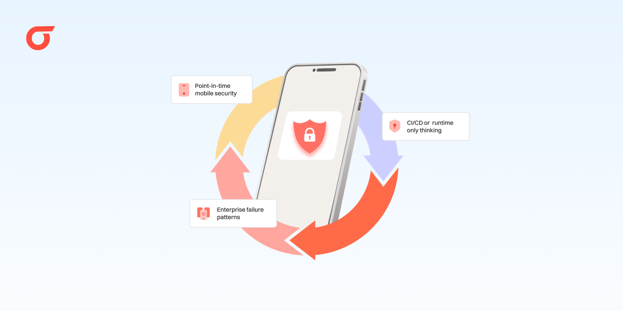
How mobile risk evolves beyond point-in-time validation


Dimension

What happens in mobile

Why point-in-time fails

Deployment control

Apps run on distributed, user-controlled devices

No centralized patching or instant remediation

Update cycle

App store approval + slow user upgrades

Fixes do not propagate immediately

Privacy disclosures

Locked at submission

Behavior drift creates compliance gaps

SDK dependencies

Third-party code changes independently

Risk surface shifts without new releases

API exposure

Backend usage patterns evolve

Abuse can emerge post-release

Threat landscape

Attack techniques adapt continuously

Assessment becomes outdated quickly

Audit & governance

Decisions reviewed months later

No structured evidence tied to the release moment

What “continuous” actually means in mobile app security

“Continuous” is often misunderstood.

It does not mean:

  • Running scans more frequently
  • Adding another runtime agent
  • Watching production traffic without context

In mobile security, continuous means this:

Risk is reassessed whenever the app, its dependencies, its exposure, or its operating environment changes.

So, the Continuous Mobile Security Lifecycle provides a plan to teams on how mobile security must operate in practice, not as a single gate or final review, but as a sequence of security decisions that span development, release, distribution, and real-world use.

Instead of treating security as something to “check off” before launch, this lifecycle recognizes that mobile risk changes as the app moves forward, from code and SDKs in CI/CD, to app store exposure, to runtime behavior, and emerging threats that weren’t visible at design time.

Its purpose is not only to detect issues early, but to create durable visibility and accountability at every stage, so teams can prevent repeat failures, explain past decisions, and adapt as mobile attack surfaces evolve after deployment.

In a nutshell, continuous mobile app security requires reassessing risk whenever there are changes in:

  • Code and configuration
  • SDK and third-party libraries
  • Backend API behavior and integrations
  • App store listings, metadata, and distribution footprint
  • User geography, regulatory context, and data flows
  • The evolving threat landscape, including AI-driven abuse

Continuous security is not a feature you turn on.
It is a discipline that spans the entire mobile lifecycle.

The canonical continuous mobile security lifecycle

Mobile risk is not a single event.
It is introduced early, amplified during development, exposed at release, and exploited in production.

To manage it effectively, organizations need a lifecycle model, not isolated tools or periodic assessments.

The Continuous Mobile Security Lifecycle maps how risk enters, evolves, and shifts ownership as a mobile application moves from ideation to real-world operation.

Crucially, it begins before development.

Stage 1: Security by design

Risk originates at ideation.

Every feature decision defines future exposure:

  • What data is accessed?
  • What permissions are required?
  • What APIs are exposed?
  • What third-party SDKs are integrated?

If security is not embedded at this stage, downstream controls become compensatory rather than preventive.

Key takeaway: Security requirements must sit alongside functional requirements in product planning.

Ownership: Product + Architecture + Security

Stage 2: Secure development

As architecture becomes code, risk density increases.

Common failure points include:

  • Insecure data storage
  • Weak authentication logic
  • Misconfigured permissions
  • Hardcoded secrets
  • Unsafe API integrations

Security must be integrated into CI/CD, not deferred to pre-release testing.

Key takeaway: Security validation must operate continuously within engineering workflows.

Ownership: Engineering + Application Security

See how mature teams structure release readiness before submission.

Explore Appknox’s release readiness framework

Stage 3: Pre-release security validation

Before distribution, the application must be validated against exploitable weaknesses.

Unlike web systems, mobile apps operate outside centralized control once deployed.

Pre-release validation should include:

  • Static and dynamic testing
  • Business logic abuse testing
  • Reverse engineering assessment
  • Obfuscation verification

Key takeaway: No production release without structured security validation.

Ownership: Security + Engineering

See how mature teams structure release readiness before submission.

Explore Appknox’s release readiness framework

Stage 4: Deployment hardening

Once live, the threat model changes.

Attackers analyze binaries. APIs are probed. SDK behaviors are manipulated.

Hardening measures include:

  • Runtime protection
  • Anti-tampering controls
  • Integrity checks
  • API abuse safeguards

Key takeaway: Production deployment must include active defensive controls.

Ownership: Security Engineering + Platform Teams

Understand how runtime protections are tested, and how attackers bypass them.

Read the Mobile Binary Protection Guide

Stage 5: Runtime monitoring and threat response

Risk becomes behavioral in production.

Fraud patterns, credential abuse, device compromise, and automation attacks emerge only at runtime.

Organizations must:

  • Monitor anomalies
  • Detect live tampering
  • Correlate mobile risk with backend systems
  • Respond in near real time

Key takeaway: Security cannot stop at release. Continuous visibility is required.

Ownership: Security Operations + Fraud + Risk Teams

Stage 6: Continuous feedback and adaptation

Security findings must inform upstream decisions.

Runtime insights should influence:

  • Feature design
  • Architecture changes
  • SDK selection
  • Control refinement

Security maturity is defined by adaptation speed, not vulnerability count.

Key takeaway: Establish closed-loop security governance.

Ownership: Product + Engineering + Security Leadership

Executive summary: Continuous mobile security lifecycle


Stage

Where risk enters

Primary risk type

Executive focus

Primary ownership

Security by Design

Feature ideation

Structural exposure

Embed security in product planning

Product + Architecture + Security

Secure Development

Code implementation

Technical vulnerabilities

Integrate security into CI/CD

Engineering + AppSec

Pre-Release Validation

Release preparation

Exploitable weaknesses

Enforce the release of the security gates

Security + Engineering

Deployment Hardening

Production deployment

Adversarial manipulation

Implement runtime defenses

Security Engineering

Runtime Monitoring

Live user interaction

Behavioral and fraud risk

Maintain continuous visibility

SecOps + Fraud Teams

Continuous Feedback

Post-incident learning

Strategic blind spots

Close the security loop

Product + Security Leadership

Why securing one stage never secures the entire app

The most common mistake organizations make is assuming that securing one stage secures the entire app.
Unfortunately, it doesn’t.

Mobile apps don’t fail because teams ignore security.
They fail because security is applied unevenly across stages, while risk continues to move forward.

A few examples we, at Appknox, see repeatedly:

  • A team invests heavily in CI/CD security and catches build-time vulnerabilities early, only to be blindsided later by app store impersonation, cloned apps, or unauthorized changes to their store presence that no one was monitoring.
  • An app passes app store review and compliance checks at launch, but its runtime behavior changes over time as SDKs update, APIs evolve, and usage patterns shift, introducing risks that no one re-evaluates.
  • A security team deploys runtime protection to detect abuse, but lacks the build-time context to understand why the same vulnerabilities keep resurfacing across releases.

Each of these teams “secured” something. None of them secured the app end-to-end.

That’s because each stage of the mobile lifecycle introduces a different class of risk, and each class requires different visibility, controls, and ownership. What protects you at one stage often says nothing about what happens next.

When organizations focus on a single stage:

  • Risk doesn’t disappear; it moves forward.
  • Blind spots don’t close, but they shift.
  • Incidents don’t feel preventable. They feel surprising.

Role of a mobile security lifecycle approach

Continuous mobile app security isn’t about expanding the to-do list.

It’s about ensuring that risk is re-examined as the app moves from build to release to public distribution to real-world use.

Many organizations still assume that a single strong control, static testing, runtime protection, or compliance certification, can compensate for blind spots elsewhere.

As Harshit Agarwal, CEO of Appknox, explains:

The biggest misconception in mobile security is that one strong control can compensate for blind spots elsewhere. It can’t. Security maturity is about continuity, not intensity.”

When teams understand mobile security as a sequence of connected decisions rather than a single control point, failures stop feeling random.

They become predictable.

And preventable.

Measuring maturity: How enterprises operationalize the lifecycle

Every organization claims to practice continuous security.

The difference is not in the claim, but in the operational evidence.

In mature enterprises, lifecycle thinking is reflected in how decisions are owned, documented, monitored, and fed back into product evolution.

Five patterns consistently separate structured lifecycle governance from fragmented control.

1. Formal stage ownership

Each lifecycle stage has defined accountability — not shared responsibility in theory, but named ownership in practice.

  • Who signs off on security requirements during feature planning?
  • Who validates build-time risk before release?
  • Who monitors runtime exposure?
  • Who feeds findings back into product decisions?

Unclear ownerships lead to security gaps becoming invisible. However, when the ownership is explicit, blind spots become traceable.

2. Structured release evidence

Security validation is documented at the moment of release as structured artifacts tied to:

  • Build version
  • Dependency state
  • Test coverage
  • Control posture

Months later, when audits, incidents, or regulator questions arise, the organization can reconstruct what was known and validated at that point in time.

Without release evidence, security posture becomes anecdotal.

3. Runtime telemetry linked to build context

Production monitoring is connected back to the build that introduced it.

When runtime anomalies occur, such as tampering attempts, abuse patterns, and SDK misbehavior, teams can trace:

  • Which release introduced the condition
  • Which dependency version was active
  • Which architectural decision shaped exposure

Without this linkage, runtime security becomes reactive.
With it, it becomes diagnostic.

4. Store and distribution exposure monitoring

Mature organizations monitor how their app exists in the ecosystem, not just how it behaves in production.

This includes:

  • Store metadata integrity
  • Unauthorized listing changes
  • Clone and impersonation detection
  • Regional distribution anomalies

Mobile exposure is public and persistent. Governance must extend beyond code.

5. Closed-loop feedback into product planning

Findings from the runtime and distribution stages influence upstream decisions.

  • SDK selections are revisited.
  • API design patterns are refined.
  • Feature architectures evolve based on observed abuse.

Security maturity is visible when insights travel backward, not just forward.

What continuous mobile security lifecycle maturity looks like

Enterprises that operationalize the lifecycle demonstrate:

  • Clear accountability across stages
  • Evidence that survives audits
  • Traceability between runtime risk and build decisions
  • Visibility beyond the binary
  • Adaptation built into product evolution

The lifecycle becomes real when it governs decisions, not just discussions.

Mobile security is a discipline, not a gate

Mobile security does not fail because controls are weak.

It fails when controls operate without continuity.

The Continuous Mobile Security Lifecycle connects decisions across stages, from feature architecture to runtime telemetry and back again.

When security moves with the application, risk becomes measurable, explainable, and predictable. The chances of incidents feeling sudden, even when they are structurally inevitable, get considerably reduced.

Enterprise maturity is not about adding more gates. It is about establishing ownership, evidence, and feedback across the full lifecycle of the app.

Mobile systems evolve.
Threats evolve.
Governance must evolve with them.

That is what continuous security operationalization truly means.